Growing up I learned three cardinal rules about stuff.
1. Have all the best, newest, fanciest things you can buy.
2. If something breaks, buy a new one.
3. Show your love with presents––as many as you can afford to buy, as often as you can afford to give.
These were pretty standard cultural norms, but over my lifetime, they’ve started to evolve. As climate change worsens, we are all increasingly aware of our impact and lots of “environmentally-friendly” products have appeared on the market.
Now, instead of styrofoam plates, you can buy compostable plates. Instead of flimsy plastic bags, you can carry your groceries in a reusable tote bag from your favorite store. You can buy clothes made of organic cotton.
And none of these are bad things, per se, but if consumption is a driver of waste (sending old things to landfills) and pollution (because of the energy required to make and ship all these products), then consuming different stuff doesn’t fully address the problem.
The three R’s are meant to be followed in order:
REDUCE: buy/use less of everything
REUSE: treat nothing as disposable
RECYCLE: after we can no longer reuse something for anything else, then––and only then––should we recycle
For me, it’s also crucial to consider where and how things are made because I don’t want my organic cotton t-shirt to cost someone’s life (and, as we’ve seen, that’s not an exaggeration).
Instead of the rules I grew up following, I’m trying to form new values. These are the questions I now ask myself:
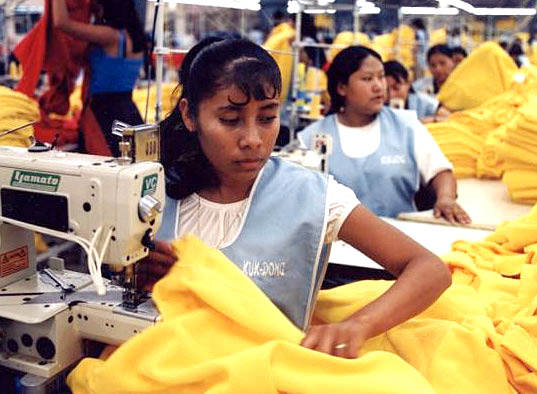
1. Where was it made, and who made it? Usually, the answer is this:
2. Can I buy it used?
3. If I can’t buy it used, is there an ethical alternative?
It’s not a perfect system. I still end up buying lots of stuff that comes from sweatshops, but it does help me buy less.
Another thing that has helped is thinking of myself not as a consumer but as a steward of everything I own. It’s my job to care for it, fix it, and ensure that it doesn’t end up in a landfill if there’s any way to avoid it.
Take, for example, my iPhone. I know that the story of its production is unspeakable injustice: from children forced to mine rare minerals to factory workers exploited in China, how many people suffered just so I could have this tiny supercomputer in my hands?
I feel terrible admitting this, but even though I know all of these things are wrong, I still love having this phone.
Until there is a recycled, fair-trade, ethical smartphone, I don’t want to do without it. So I do the next best thing. I keep it in a heavy-duty case to prevent it from breaking. I work hard to ensure it never gets wet. Once the screen broke and I paid to have it repaired, even though it would have been cheaper to replace the phone altogether. I could get easily get a newer “better” one, but I won’t until this one stops working or is completely obsolete.
Because I treat my possessions as a responsibility, I can usually talk myself out of buying something on a whim.
It’s much harder to resist buying gifts. I worry that the people I love won’t know I love them. Will they think I am stingy if their gift comes from a thrift store? Often the next best ethical alternative is too expensive for me to afford, and my gifts end up looking puny.
For example, once my mom gave my niece Victoria a pink tent in the shape of a castle that was big enough for her to play in. I gave her a feminist children’s book.
Guess which one she liked more.
The castle tent goes against everything I believe––aside from the problems with its production, it reinforces messages about femininity that I disagree with. I want Victoria to grow up knowing that she is intelligent, brave, compassionate, and that the least important thing to be is a pretty princess.
Still, l wish I had given her something that made her as happy as that castle did.
I want to give meaningful gifts that don’t go against my convictions but do make the people I love feel happy, and I worry that it will take years for me to strike that balance because it is the opposite of what I know how to do. (Will it be too late to fix my reputation as a hopeless gift-giver? Will I even have friends and family by the time I figure it out?!) I guess I just have to hope that people really believe it’s the thought that counts. Because if there’s one thing I can say about my weird gifts, it’s that they come with an awful lot of thought.
 smoothliminal
The best gift you´ve given me is your example, believe it or not, you´ve made a big impact and I´ve become a little bit more responsable about my shopping habits. Thank you!!
Thank you, Menry! You are a great example to me, too!