You know how sometimes you’ll say something like, “Thank you for making me this present! It’s perfect, and I love it” and the person who made it will respond by saying, “Oh, it was nothing” (even though they clearly put a lot of time and effort into it)?
Well, that’s how the Midwesterners I know respond to every compliment. The Midwesterners I know have elevated the art of deflecting compliments to an Olympic sport.
I’ve spent years trying to decipher whether giving compliments is good or bad because it seems like every time I do, the person being complimented feels obligated to put themselves down, and then I try to convince them to be proud of themselves, and they insist they’re not special, and on and on, until I think we both walk away from the interaction feeling a little dizzy.
When I realized that deflecting compliments is a SPORT, however, suddenly everything made sense. Here are the rules for winning: the quicker and more self-deprecating you can be in response to a compliment, the more points you get. To win, leave your opponent (the compliment-giver) speechless.
I know someone who will be a gold medalist as soon as this sport is ratified by the IOC. He is lightning fast and able to deflect any compliment, big or small, expected or unexpected, day or night.
Take this interaction for example…
Me: This lasagna is literally the best lasagna I’ve ever had. Future Gold Medalist: Well, I packed up the leftovers for you, so you’ll be sick of it soon enough.
Now, what are you supposed to say to that?
There’s really nothing you can say, and that’s why he’s the undisputed world champ (but don’t tell him that!).
1) Life is happier when you love people as they are instead of trying to change them (that goes for everyone: friends, family, yourself).
2) You only fail when you try, and all your worst failures eventually become your best anecdotes, so really everything is a win-win.
3) Migration is a human right, and 100 years from now, people will be horrified that we ever thought otherwise, so we should work for open borders now.
4) If you compare yourself to people who have more, you’ll feel like you don’t have enough. If you compare yourself to people who have less, you’ll realize how much you have, and you can use that awareness to motivate you to give more and work harder to reduce inequalities.
5) Food tastes better when we share it (even if all we can do is drop it off at a neighbor’s door).
6) Dogs, sunrises, flowers, toilets that flush, elevators, buses, cats, music, funny tweets, tiktoks, homemade signs, chamoy, babies, abuelit@s, strangers doing nice things for each other, choirs, cookies, lipstick that matches the dress and the shoes! Everything is incredible if you really think about it. You just have to stop to think about it.
7) You’re the protagonist of your own life, so do the things that matter to you and don’t worry about what other people think (they’re mostly busy starring in their own lives!).
8) I don’t think anyone ever regrets saying please, thank you, I love you.
9) Ask for what you really want, and never expect anyone to read your mind.
10) Vote, join a union, work together, help take care of the people around you! Independence is a dangerous myth. Interdependence is powerful (and it’s the only choice we have, anyway).
(I wrote this last year as I reflected on the decade that was coming to a close, and re-reading it has helped me take comfort and make better decisions this year, so I decided to post it here. Also, wow, number 10! I thought I knew about interdependence, but this year has shown us how connected we really are. Our lives are in each other’s hands. I try to remember this every day, and I think it’s helped me keep things in perspective.)
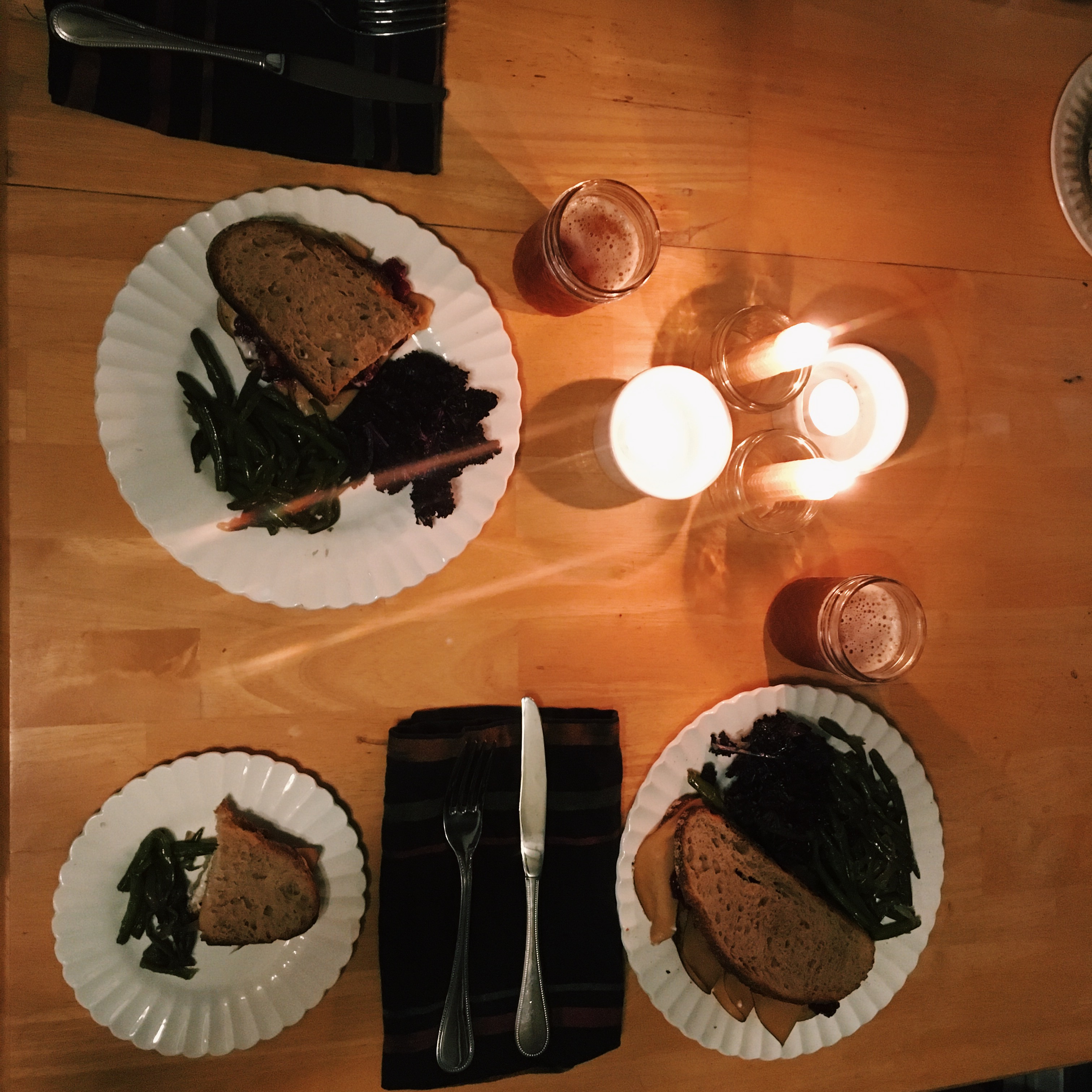
This year for our little Thanksgiving, Devin and I skipped the main meal and went straight to leftovers, opting for sandwiches instead of a main course. I loved what we ate so much that I decided to put all the recipes here so that we can find them in future years, when I hope we will be able to share them with more of the people we love. They’re also good recipes for anyone who’s wondering what to do with leftover turkey (or tofurkey : ), an extra bag of cranberries, or frozen green beans.
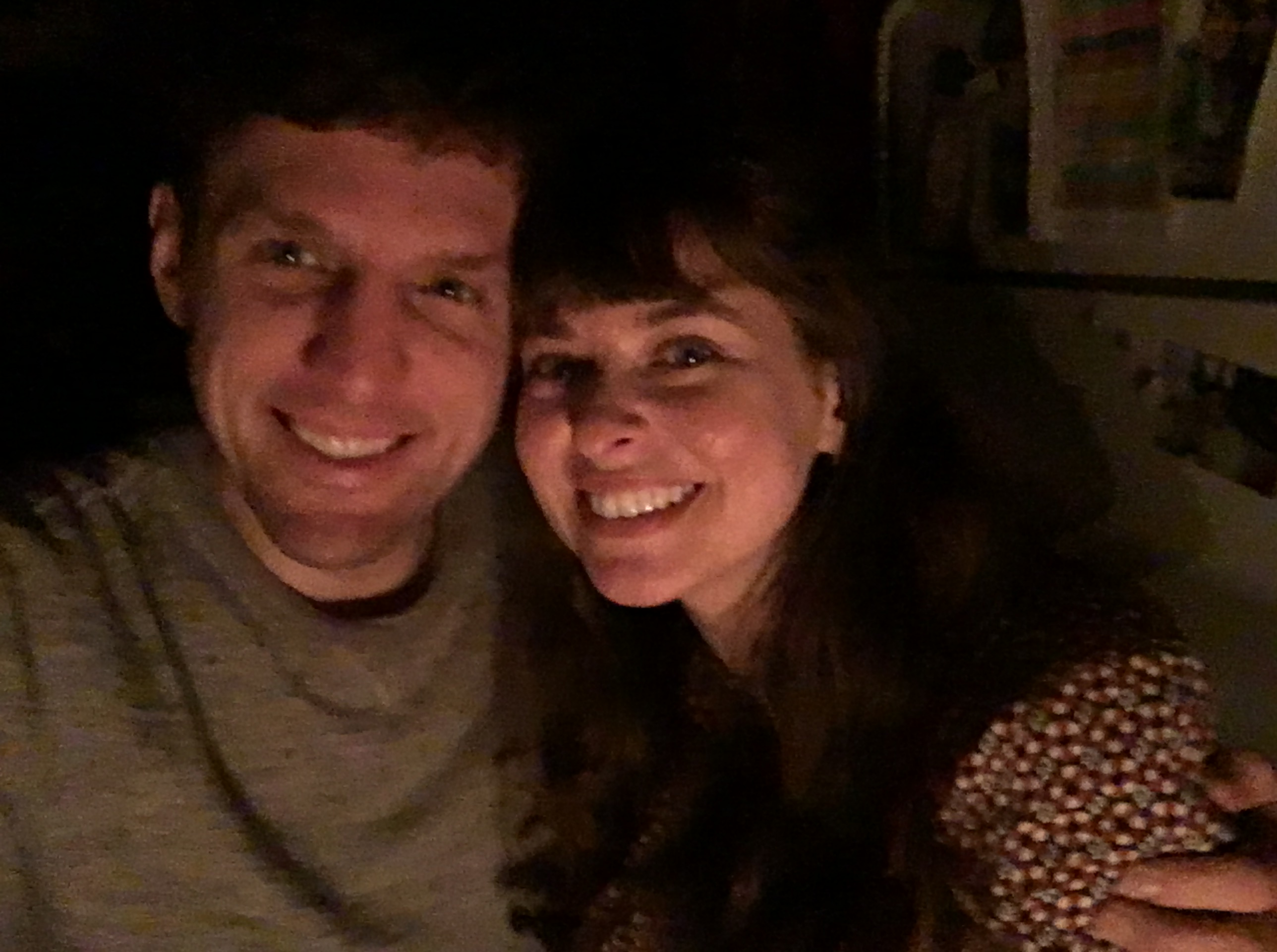
Devin and I eating in the kitchen, by candlelight
OK, so first things first: The Sandwich. Devin made sourdough bread using a recipe from Flour, Water, Salt, Yeast, a very good cookbook for any aspiring breadmakers. The bread was fresh from the oven, and we just added a little mayo (my favorite kind is Just Mayo, but any kind works) and some tofurkey (but you could use turkey or any other kind of meat or “meat.” My favorite are the Tofurky-brandHickory Smoked deli slices. Non-vegetarians are always skeptical, but everyone I’ve fed them to in the past 15 years has loved them!) The crucial finishing touch for this sandwich was cranberry chipotle sauce (see recipe below).
Cranberry Chipotle Sauce
1 12-oz bag of fresh or frozen cranberries
1/2 cup sugar
1/4 cup maple syrup
1 or 2 minced chipotle peppers in adobo, depending on how spicy you want it to be. If you don’t have a can of chipotles in adobo, use 1/2 tsp. or 1 tsp. of chipotle powder.
1 orange, juiced
1/8 teaspoon cumin
1/8 teaspoon cinnamon
Combine all the ingredients in a small pot and cook over medium heat until the cranberries begin to burst (about 5 minutes). Lower the heat to medium low and cook for 5–10 more minutes. You’ll know it’s ready when the mixture has thickened up. This recipe is adapted from Alyssa & Carla.
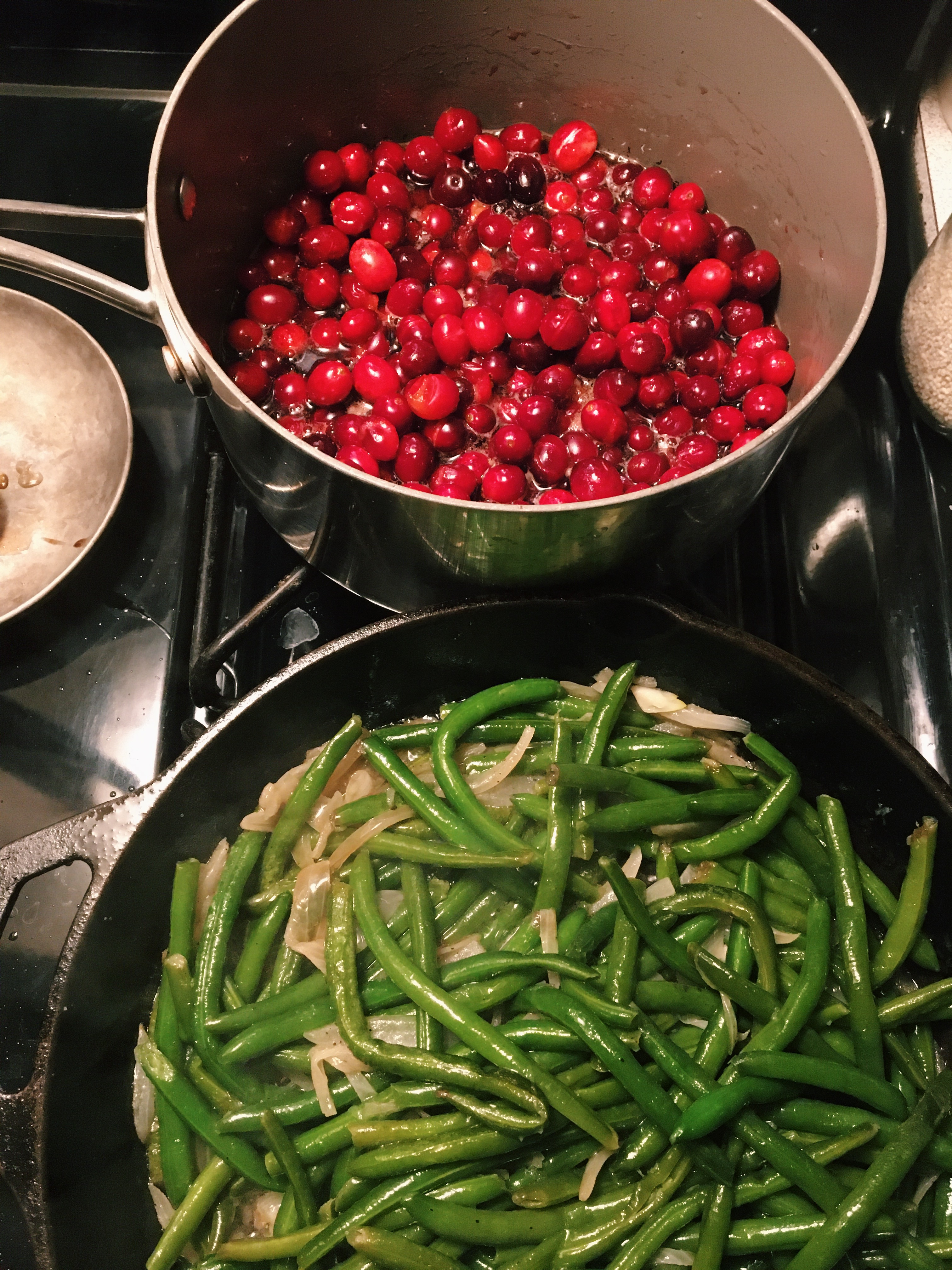
Cranberries in a pot, green beans in our skillet
Caramelized Green Beans
We also ended up with a big bag of frozen green beans, so I tried to find a new way to use them and ended up using this recipe by Lynne Curry. You can make it with butter, ghee, or olive oil, and we didn’t use the full amount (I think we used approximately 4 tbsps.). We also used onion instead of shallots and no mushrooms because we didn’t have any. The result were smooth creamy green beans that tasted like a whole other kind of vegetable, and best of all, no squeaking! (Have you ever noticed that frozen green beans usually turn out squeaky?)
We also sautéed some purple kale and had it with our meal. Even though we missed being able to gather with friends and family, it felt special to make a meal, light some candles, and sit down to eat together. (Usually, Devin and I eat at totally different times, so it really felt like an occasion!) And we even dished up a little plate for Chloe.
Our table by candlelight
I hope wherever you were, you felt loved and supported. These are hard times for all of us, but I’m finding hope in following the news about vaccines and improved treatments for COVID-19. Public health experts are still begging us to stay home, mask up, and practice social distancing,* but there is an end in sight, and I’m praying that we can all hug and breathe the same air safely someday very soon.
*Did you know: in the U.S., we call staying six feet apart maintaining “social distance,” but in Mexico, it’s called “sana distancia,” which means “healthy distance.” I think that’s kind of beautiful.
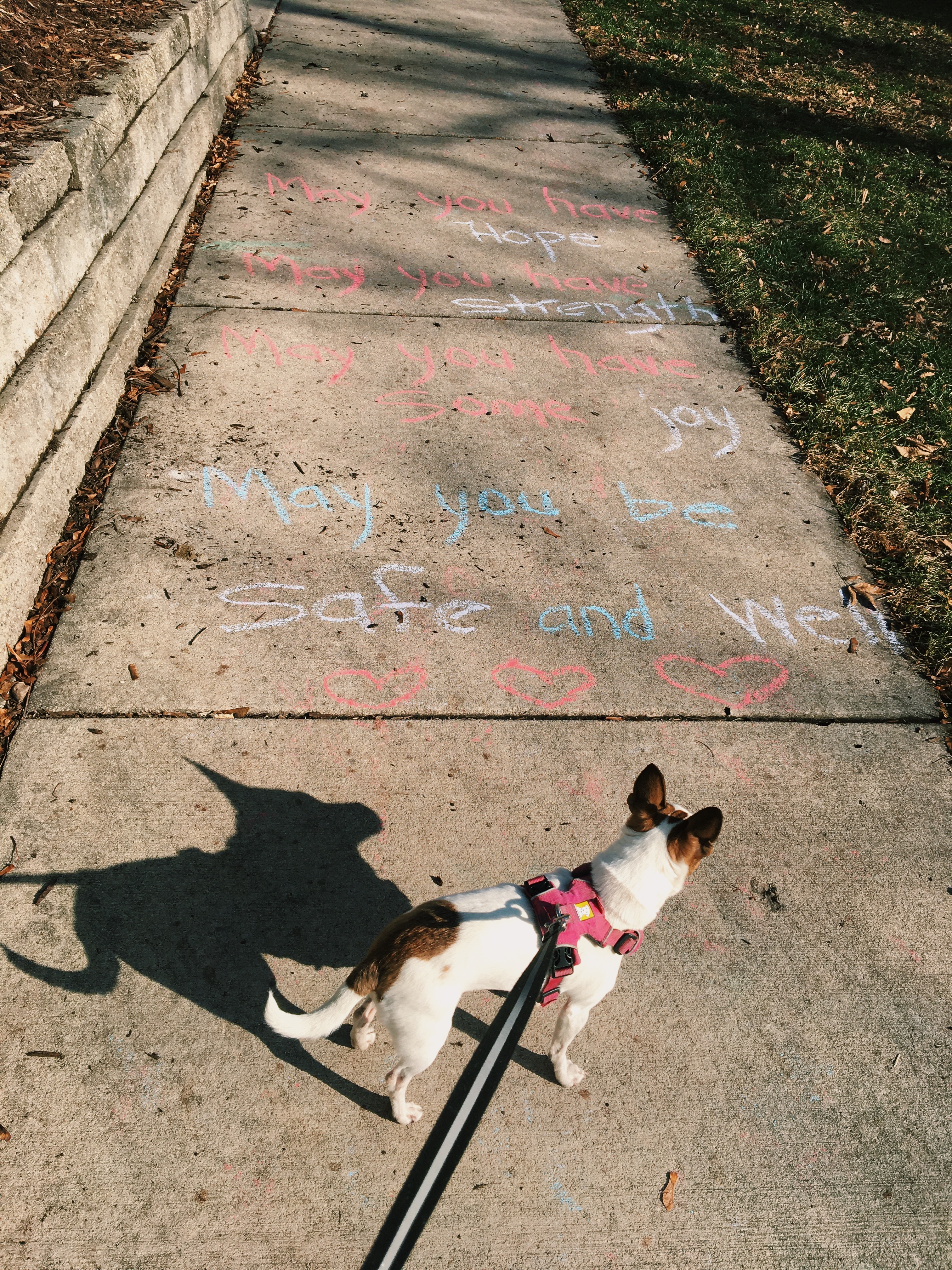
On the morning of Thanksgiving, someone wrote this in chalk on the sidewalk in our neighborhood: May you have hope, May you have strength, May you have some joy, May you be safe and well.
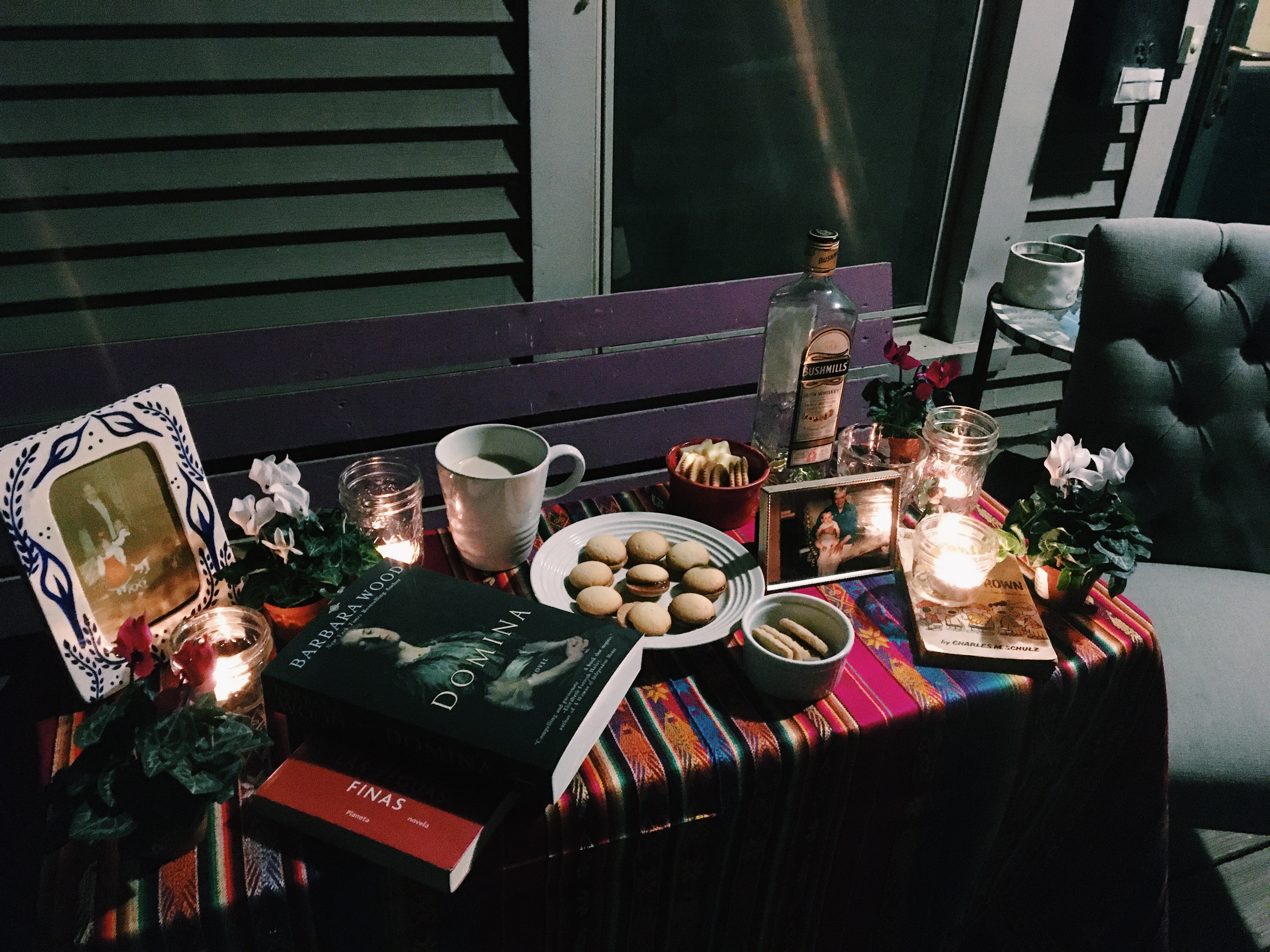
A few weeks ago, Devin and I made an ofrenda for our grandmothers. Even though I’m Mexican, my family has never been big on Día de Muertos. In fact, one of Abbita’s favorite sayings was “En vida, hermano, en vida,” which basically means “If you want to do something nice for someone, do it while they’re still alive.”
As I prepared the ofrenda for her, I could imagine her laughing and shaking her head at me, so I decided to add something she couldn’t refuse… In addition to her coffee and cookies with cajeta, I placed her favorite novel, Domina, which she liked because it is about a woman who overcomes the obstacles in her path to become one of the first (fictional) female surgeons. (Knowing her life story, it’s pretty obvious why that story would appeal to her). I also found the last book we read together, Las Yeguas Finas, so I put that one out, too. I know that if Abbita did come back to Earth for one night only, the first thing she would want is to sit down to read, and I could picture her eyes twinkling at the sight of these two books.
We also made an ofrenda for Devin’s Grandma Pat, with her favorite evening snack: cheese, crackers, and Irish whiskey. She learned to drink whiskey straight because her dad told her that it was better to know how much you were drinking than to risk drinking too many fruity cocktails, and she stuck by that rule her whole life. She also loved Charlie Brown, so we put out a book of Peanuts comics for her and an angel figurine that she gave us a couple of years ago.
One of the hardest things about the COVID-19 pandemic is that we weren’t able to gather with Devin’s family to commemorate Grandma Pat’s life. When this is over, I hope we’ll be able to go to her memorial service and share all the things we love about her with her kids, grandkids, and great-grandkids, but until then, it’s been nice to find small ways to commemorate her life, like making her an ofrenda or buying her favorite chocolate (Fannie May milk chocolate buttercreams) to share.
On the night we made the ofrendas, I thought about how I met Grandma Pat a few months after Abbita died, so they never got to know each other, but looking at their pictures in the candlelight, I could picture them talking and laughing together. It felt magical.
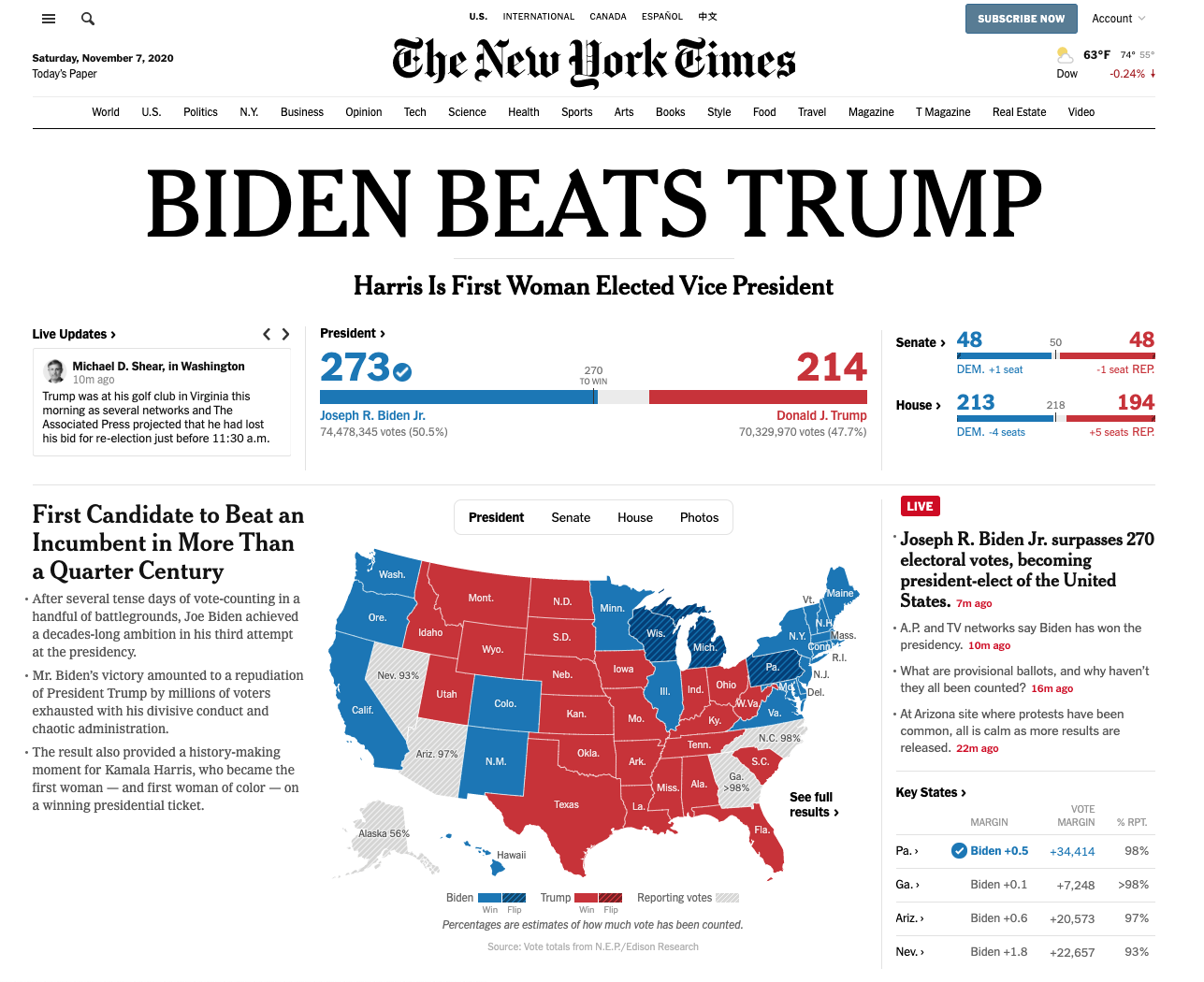
If you started out knocking on doors in Iowa and ended up helping people in your pajamas from the living room…
If you put a Biden/Harris sign in your front yard even though you were afraid your neighbors would destroy it…
If it hurt to vote for Biden because you were hoping to elect a more progressive candidate, but you voted in solidarity with the people who are most vulnerable under the Trump regime…
If you got over your phone anxiety to call voters in a faraway land called Wisconsin…
If you learned to use Zoom, OpenVPB, or ThruTalk to phonebank…
If you volunteered to get out the vote even though our current system won’t even let you vote yourself…
If you started a Facebook community to empower people to organize within their communities, using their skills and their own platforms…
If you moved to Wisconsin to help organize a ragtag band of volunteers (including a couple who was kind of fanatical about composting) and kept organizing even when the pandemic made everything so, so, so much harder…
If you trusted me to translate election information and help lead phonebanks in Spanish…
If you dedicated your time to organizing Latinx voters (who are largely overlooked and increasingly targets of disinformation and suppression campaigns)…
If you learned to say “register to vote,” “absentee ballot,” and “early voting” en español…
If you phoned a friend, texted an ex, or otherwise reached out to voters in swing states…
If you shared your most personal stories to remind people about what was at stake in this election…
If you found the courage to talk politics with your co-workers, your grandma, or your aunt…
If you spent your time talking to people who have every reason to distrust the electoral system and convinced them to vote and keep fighting for justice…
If you called me, texted me, talked to me, listened to me, brought me Mexican candy, sent me care packages, and otherwise kept me going when I felt like I couldn’t…
If you volunteered to be a poll worker or an election observer (or supported other people so they could volunteer)…
If you led countless Zoom calls with confused volunteers and comforted us when we worried this election would be impossible to win…
If you remembered all the times Trump called us animals, criminals, and rapists and refused to let him get away with it again…
If you voted and organized with hope even when it was hard to feel hopeful…
This message is for you. I love and admire you. I am infinitely grateful for your work. If I asked you to volunteer, I will almost certainly ask you to volunteer again to keep fighting for justice and human rights…
But today I feel more hopeful about those fights than I have in a long, long time. And it’s all thanks to you!
We won this election together.
We won this election together.
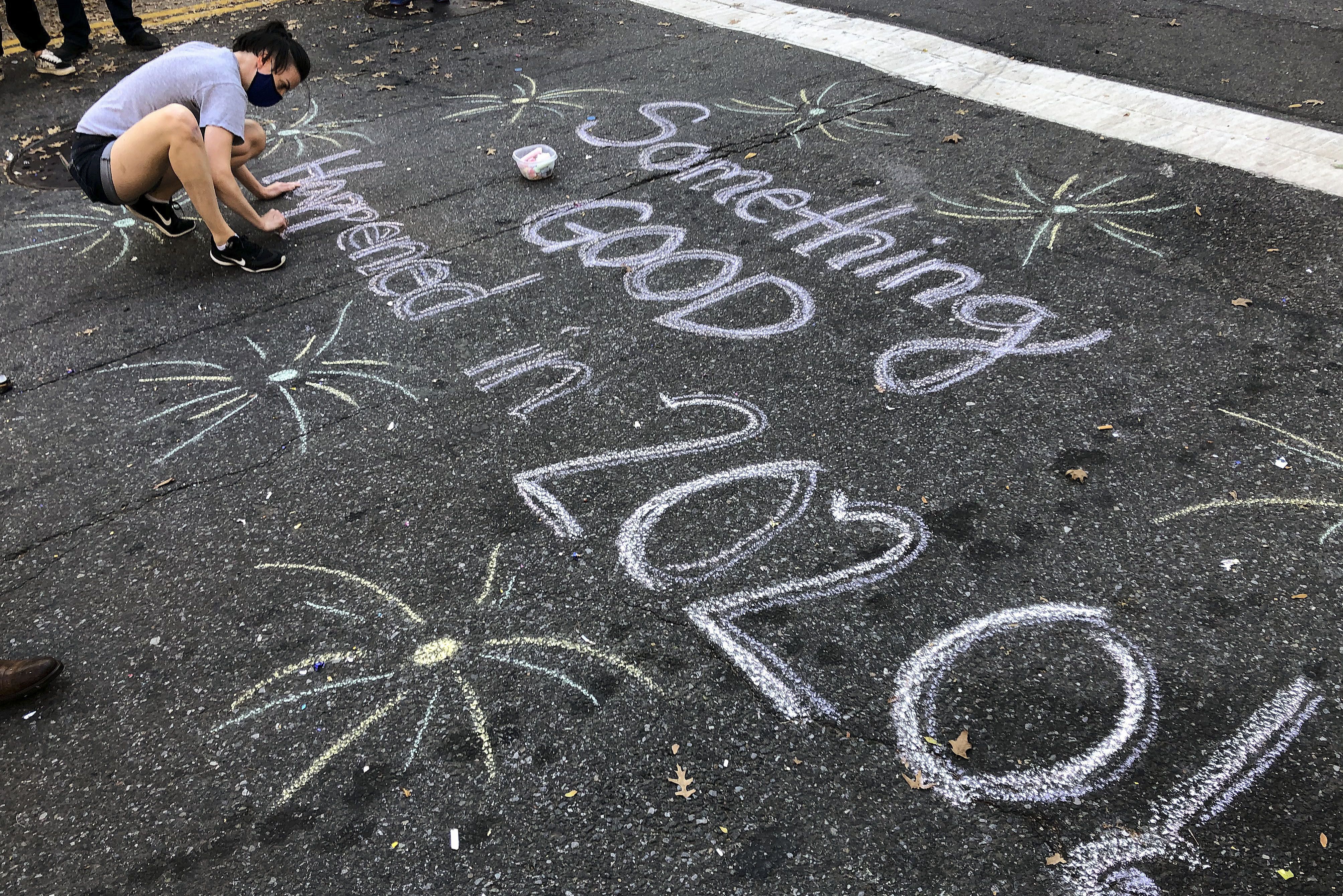
Jolin Polasek draws a sign in chalk on a street in Harlem after former vice president and Democratic presidential candidate Joe Biden was announced as the winner over Pres. Donald Trump to become the 46th president of the United States, Saturday, Nov. 7, 2020, in New York. (AP Photo/Mark Lennihan). Caption text and photo c/o Yahoo News.
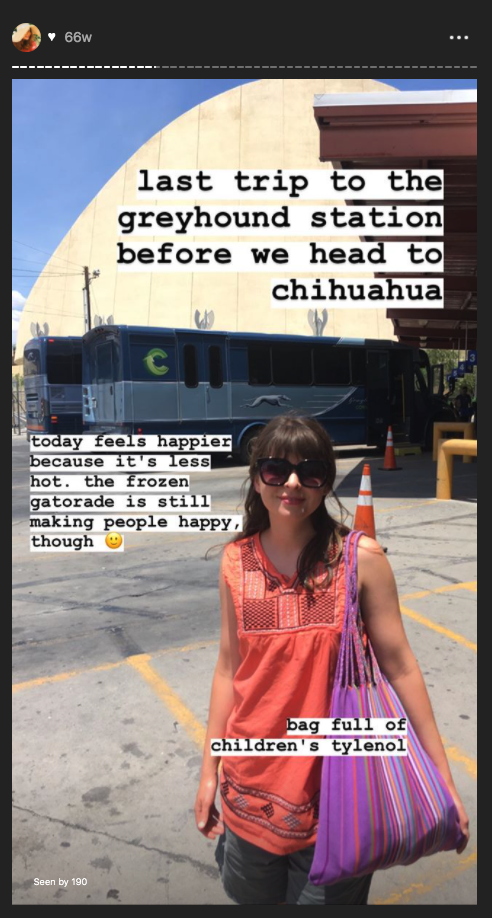
The memories come in fragments. Standing at a bus station parking lot in El Paso, the sun directly overhead. My head is throbbing from the heat. I am looking for refugees. They are easy to spot because their shoes have no laces, and they carry no luggage. All they have is themselves and a piece of paper from the U.S. government telling them what day they should show up to court. These are the lucky ones in 2019. They are allowed to stay in the country until their hearings.
I remember a mom holding a 3 year-old in her arms. I remember approaching them and offering them all we had to give: menstrual hygiene supplies, frozen Gatorades, clementines, and bananas. I remember the child clinging tightly to her mom, like she was holding on for dear life. I remember reaching my hand out to give them the bananas and how the child extended her own hand and said, “Mamá, Mamá” as she pointed at the bananas. I remember looking at her little face and knowing that it had been a very long time since she had eaten a piece of fruit.
I remember rushing to stock up on Children’s Tylenol after hearing children cough like lifetime smokers and shiver with chills from fever. This was before COVID-19, but kids were getting the flu at immigrant detention centers.
I meant to share these stories when we got back from the border. I wanted to collect backpacks to send to the border. I wanted to keep helping, but in order to do that, I would have had to talk about what we’d seen, and I couldn’t find the words.
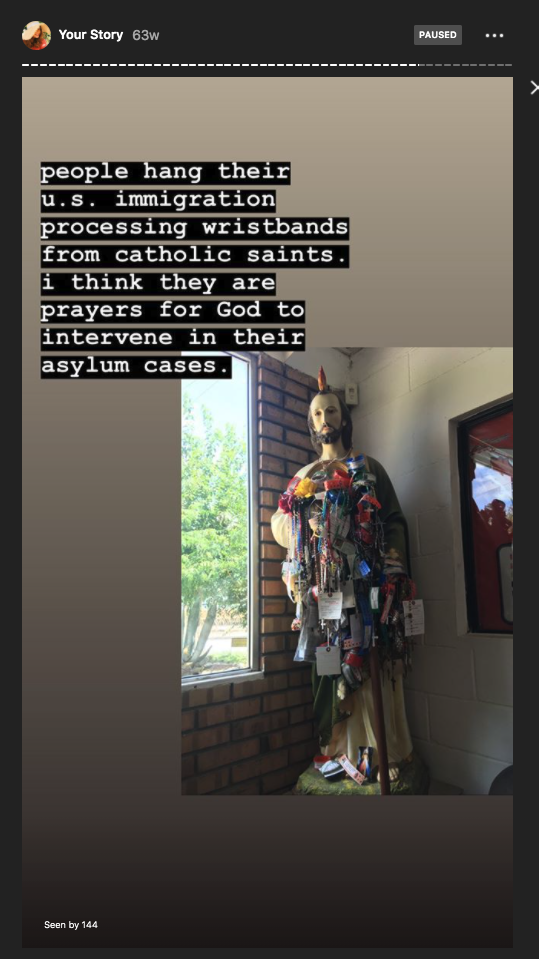
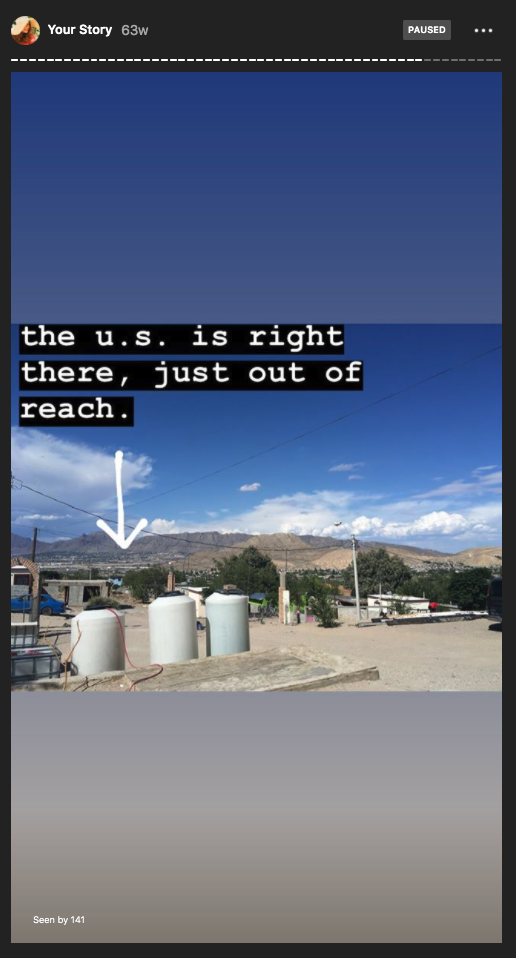
See all the pictures I posted from this trip in this Instagram story.
We went to shelters on both sides: in the U.S. and in Mexico.
I remember the father in a Juárez shelter telling me he was trying to get to Arkansas because his wife had been allowed to remain in the U.S. after applying for asylum, but he and their 7 year-old son had not. His wife was pregnant when she crossed, but she went into early labor when she got to Arkansas, and she and the newborn had been hospitalized since then.
I remember an old woman, her hair in silver braids, telling me “I didn’t want to leave my country, but they were going to kill me. If I go back, they’ll kill me.” She didn’t know anyone in Mexico, she explained, but she had family in the U.S. “It’s my only option. I want to go home, but I can’t.”
I remember the little boy who, after hearing Devin speak English to me, walked over to us and looked at his feet while he started to sing
Pollito, chicken Gallina, hen
and how he looked up and smiled when we sang back
Lapiz, pencil Y pluma, pen
I remember the three of us finishing the song
Ventana, window Puerta, door Techo, ceiling Y piso, floor
The toilets in the Juárez shelter were broken that day. (They were broken most days, a volunteer explained, because the shelter had exceeded its capacity many times over. People slept in hallways, in spaces that were supposed to be classrooms for kids. And the toilets clogged and overflowed. Too many people. Too much shit.)
The smell lingered in the air.
As we sang with that little boy, I remembered my own grandmother singing this song with me, and I thought about how kids are always kids, no matter where they are.
A statue of a saint stood on a table to our right, covered with wristbands from CoreCivic, a private prison corporation that runs immigration detention centers in the U.S. People cut off the wristbands when they were released and offered them to God with their prayers for asylum, for a return to the U.S. under less terrible circumstances. I looked at the saint and felt the prayers, and my stomach churned. To the asylum-seekers, these wristbands symbolized incarceration, starvation, and being denied showers for up to a month. But to investors (maybe even to me or to you or to anyone with a 401k or at an institution with an endowment that invests in such things), these wristbands symbolized profits.
I remember the church-run shelter we visited in Juárez and the group of girls who told me they loved to play school. I asked them who liked to be the teacher, and they pointed at a tall girl with curly hair who smiled shyly. The shelter was in a very rough neighborhood with unpaved dusty roads, nestled right against the border. I could see El Paso behind her, and I knew that if I could just get her across the border, she could have a teacher like my mom and a school with a library where she could read any book she wanted.
I wanted so badly to help her and her parents cross that line.
I remember the shame I felt at the shelters when people asked us over and over, “¿Son abogados?” and we had to shake our heads no and explain that we weren’t lawyers.
We were just Americans, there on behalf of other Americans because we didn’t agree with what our government was doing and we wanted to help. I tried to explain that, in cities across the U.S., people were protesting against the cruelty these migrants had experienced. I said, “No están solos” (“You’re not alone”). I said, “I’m not a lawyer, but I want to do what I can to help.” I felt very small, and I thought they probably didn’t feel any less alone.
I remember the nuns in El Paso telling us about the volunteers. “The volunteers here are struggling with depression. Our shelters are empty. They want to help.” The shelters in El Paso had plenty of space, beds with clean sheets, showers, bathrooms. But the migrants were being sent to Juárez instead, where the shelters were overcrowded and falling apart. The world felt upside-down.
On our last night in Juárez, we waited at the bridge to re-enter the U.S., and I fought back tears as we stood in line. When we got back to my aunt and uncle’s house in El Paso, I cried so hard I almost threw up.
I knew I had only seen a fraction. I thought about how there were makeshift shelters and tent encampments all along the border. I tried to comprehend how many more people were stuck there and thought about how many of them had family members waiting for them here in the U.S., ready to take them in if only they could cross.
I remembered Melania Trump wearing a jacket that said “I DON’T REALLY CARE, DO U?” in response to reports of children being caged like animals. I pictured Donald Trump smiling with glee at hearing about the suffering that his policies were inflicting. I knew that they were working exactly as intended.
The work we did and the supplies we took were meaningful. I know they made a difference. But it was a very, very tiny difference. To ameliorate a problem that was manufactured and could be eradicated.
This cruelty is being done in our names and being paid for with our tax dollars. And it could very easily stop.
I knew this and knew that if I wanted to help it made more sense to work to vote Trump out than it did to fundraise to try and help the people suffering under problems he created. So that is what I have done, and it’s why I’m begging you to vote for Biden and Harris if you haven’t already.
Please hear this: I have spent my whole life crossing the U.S.–Mexico border. I have never seen anything like what I saw the summer of 2019. All things considered, we saw very little of the pain that people are experiencing at the border, and we’ll never know what it’s like to live through this cruelty ourselves, but the suffering I witnessed will haunt me forever. I don’t think I could bear to see how much worse things could get if Trump gets four more years. I just keep thinking “This cruelty is being done in our names and being paid for with our tax dollars. And it could very easily stop. It is our responsibility to stop it.”
I am begging you to vote for Biden and Harris because I don’t want to find out.
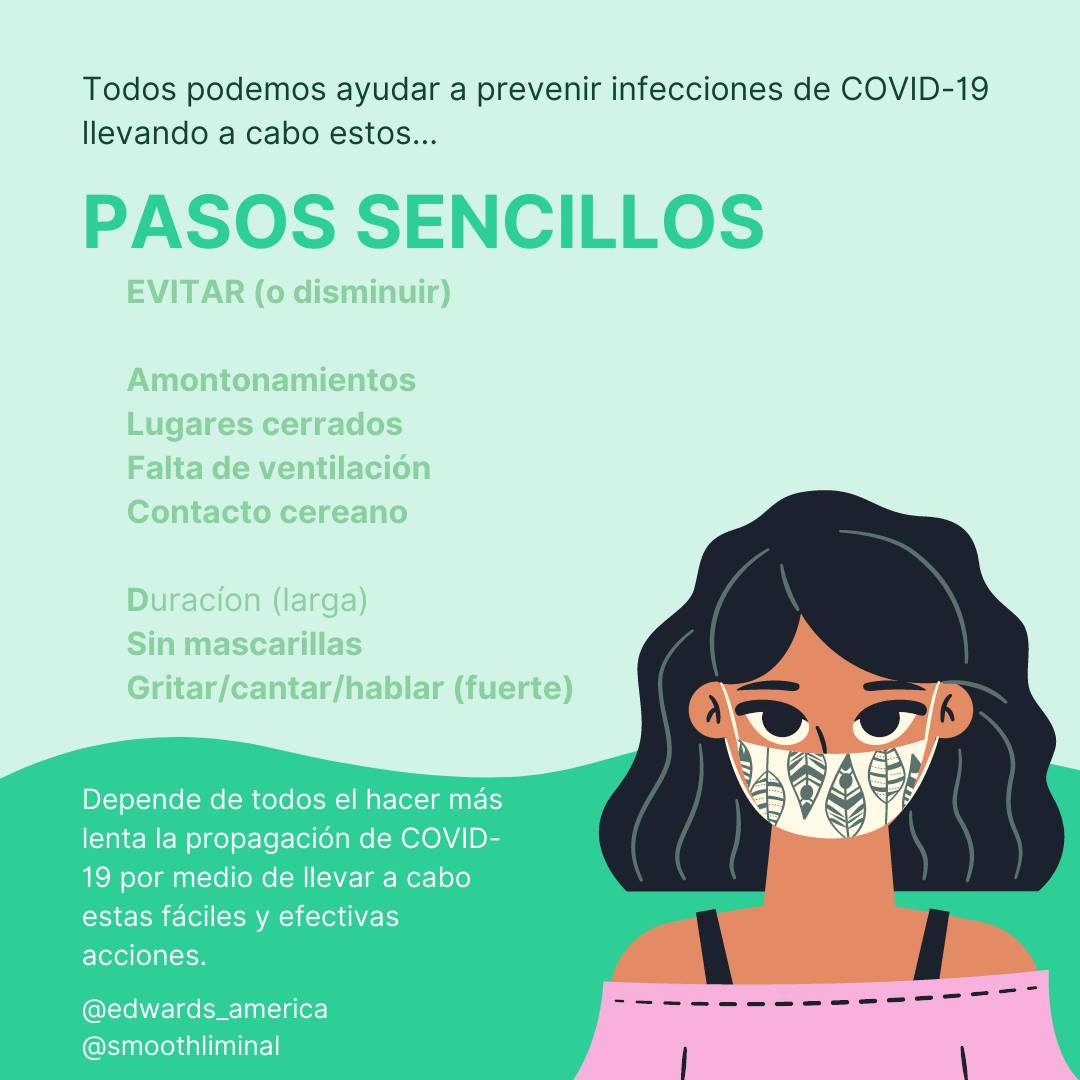
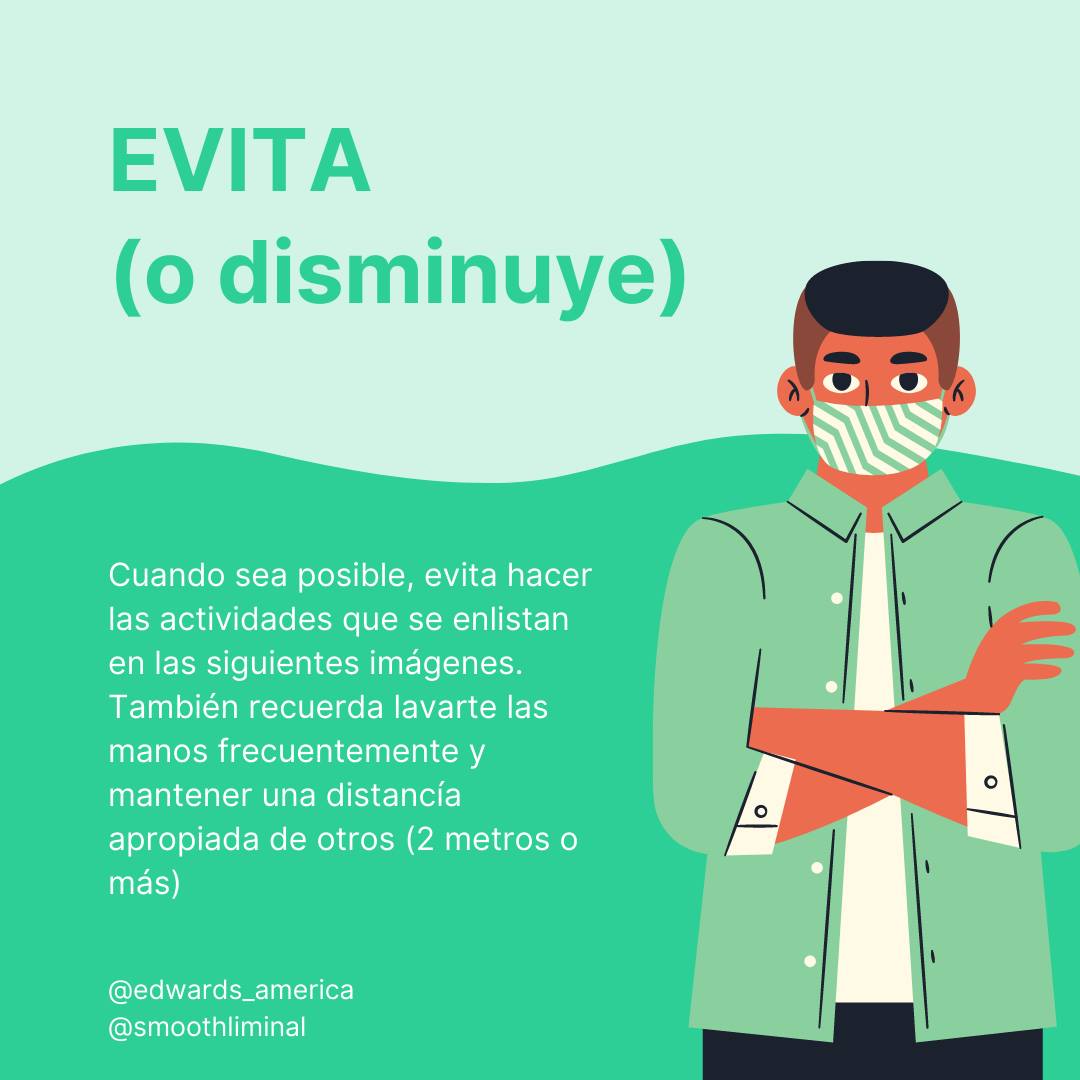
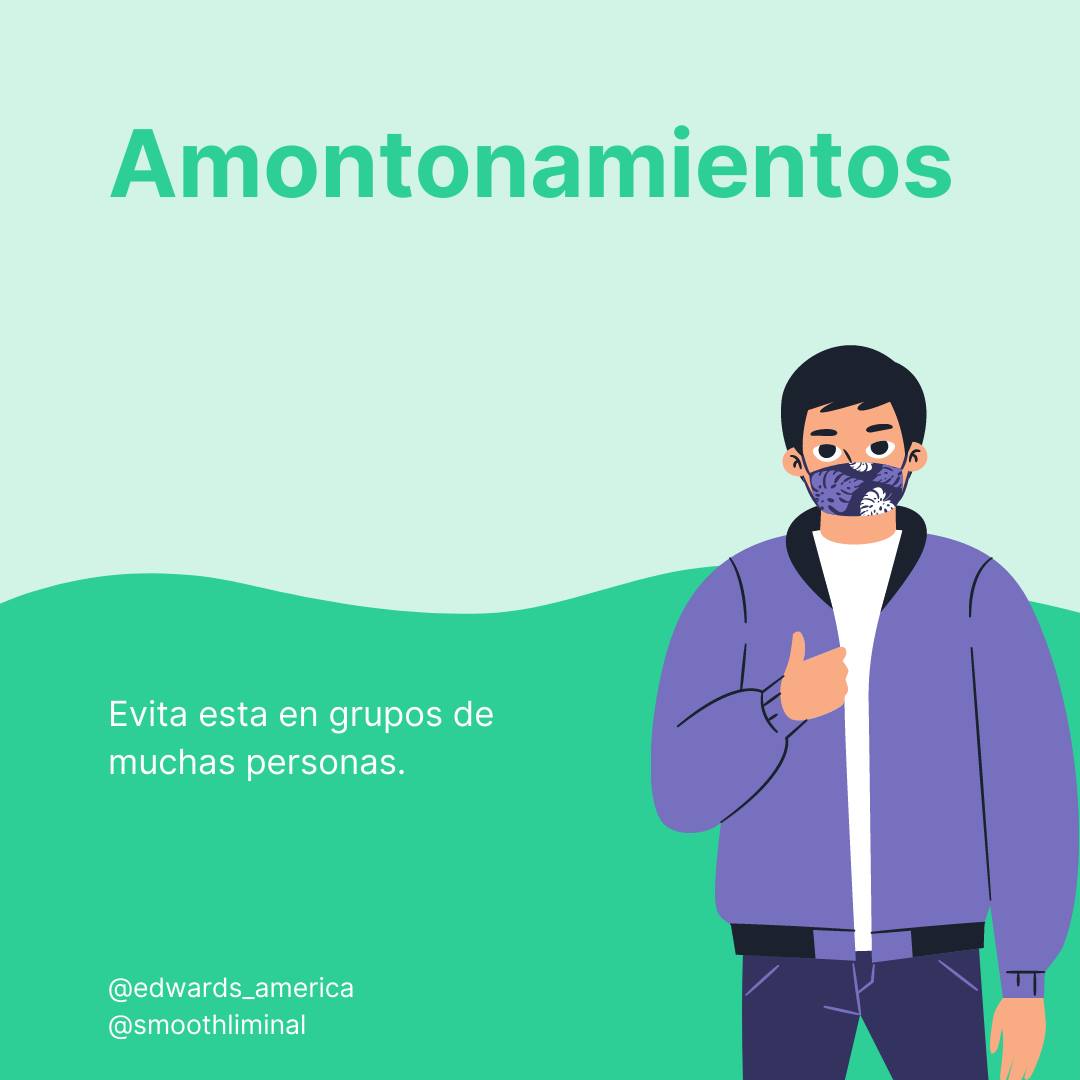
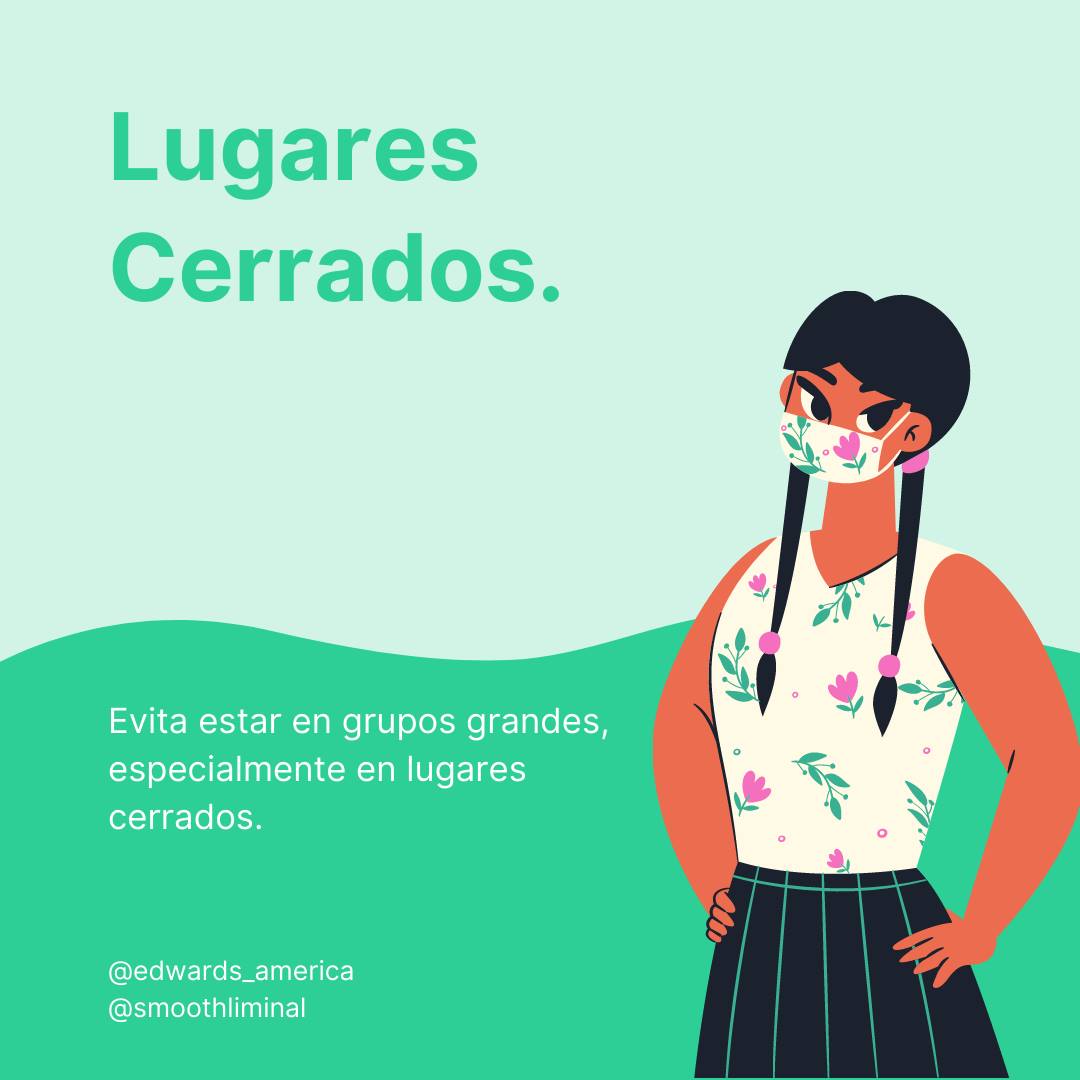
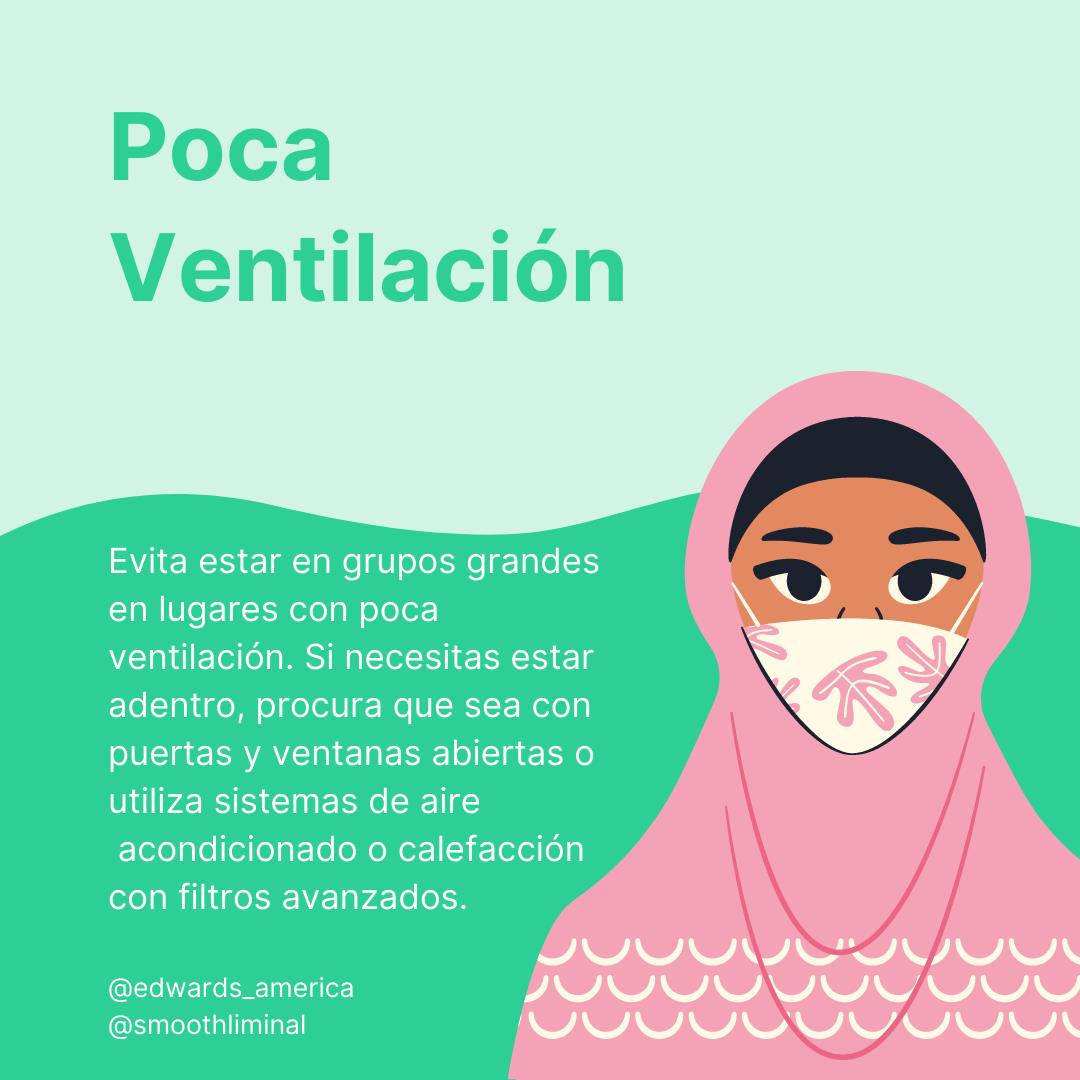
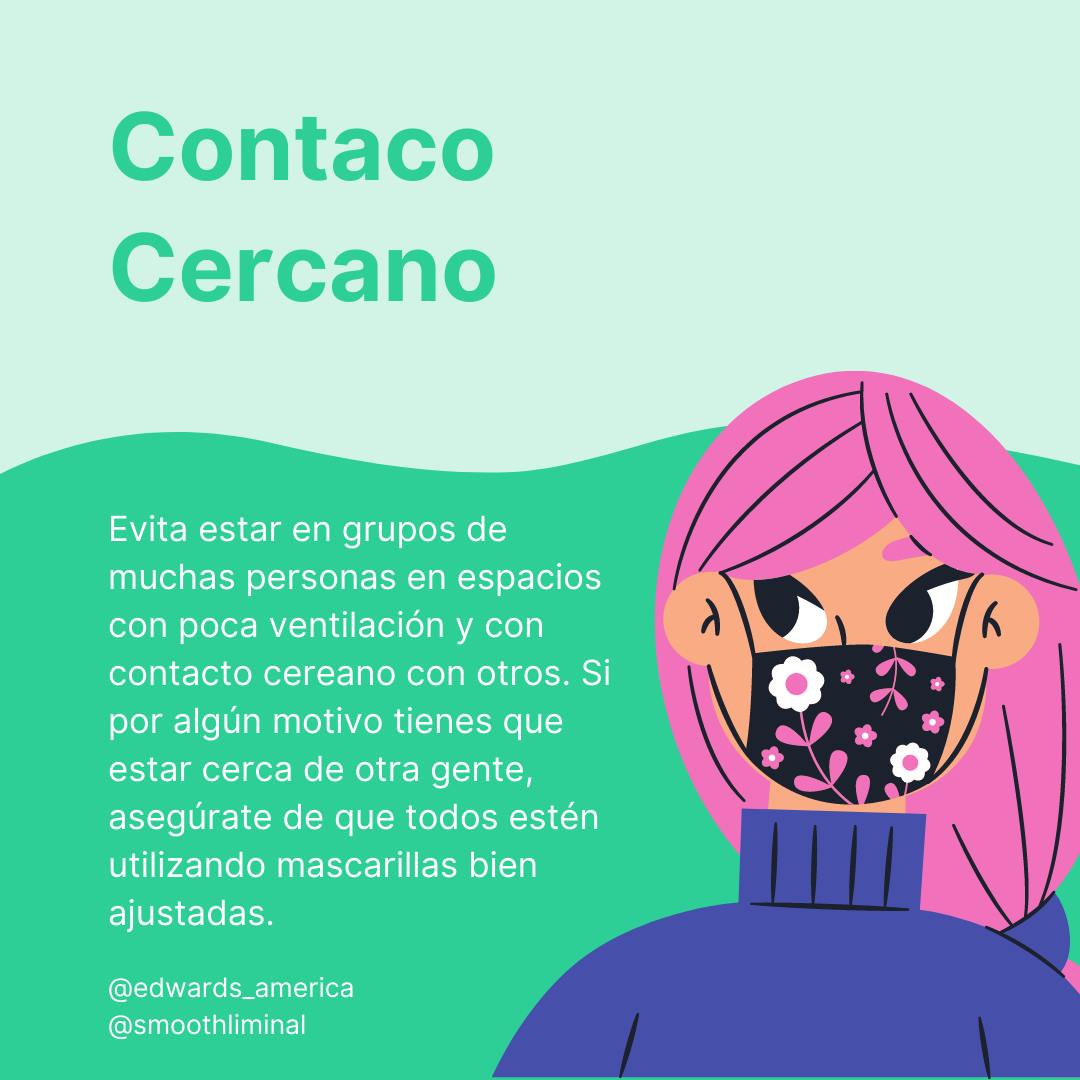
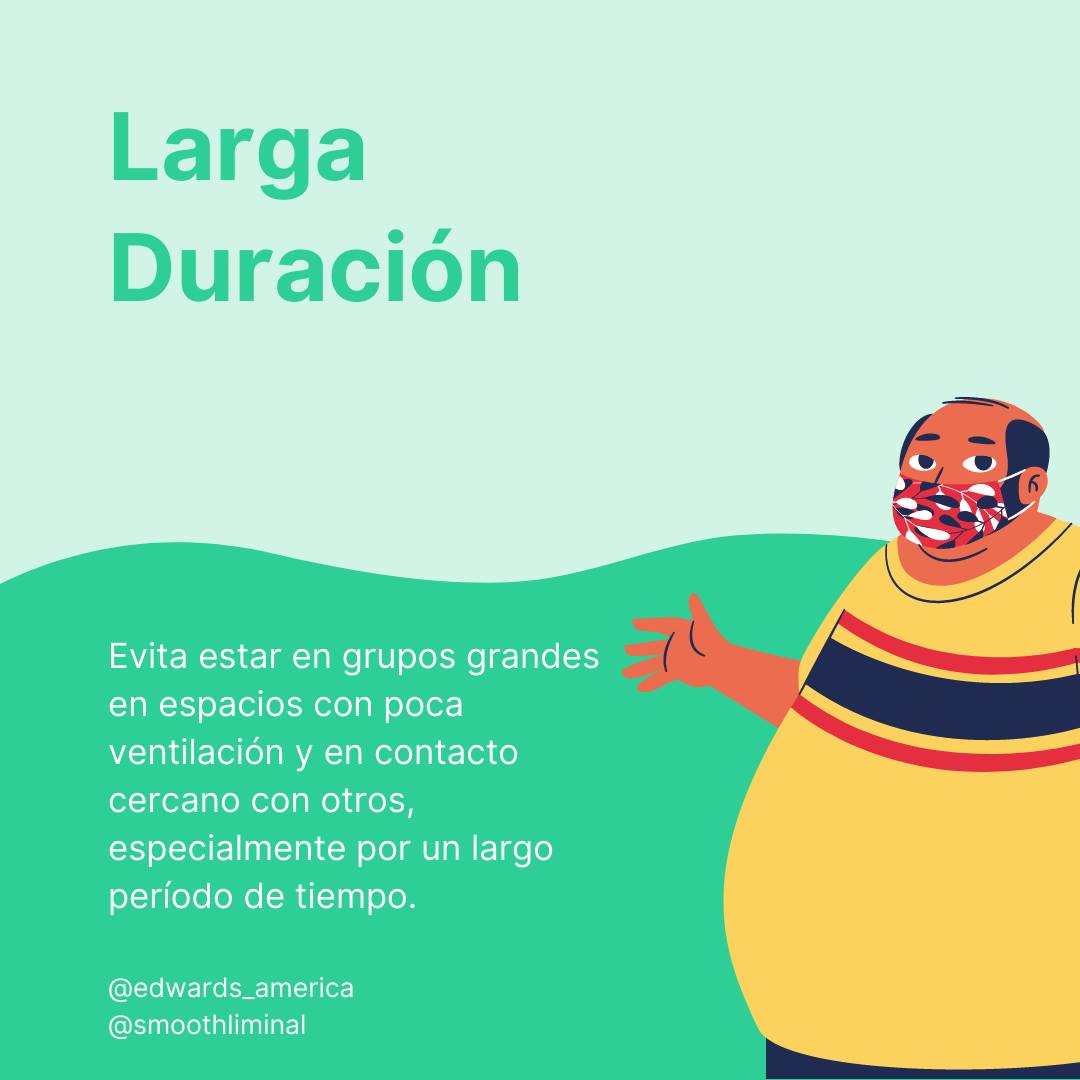
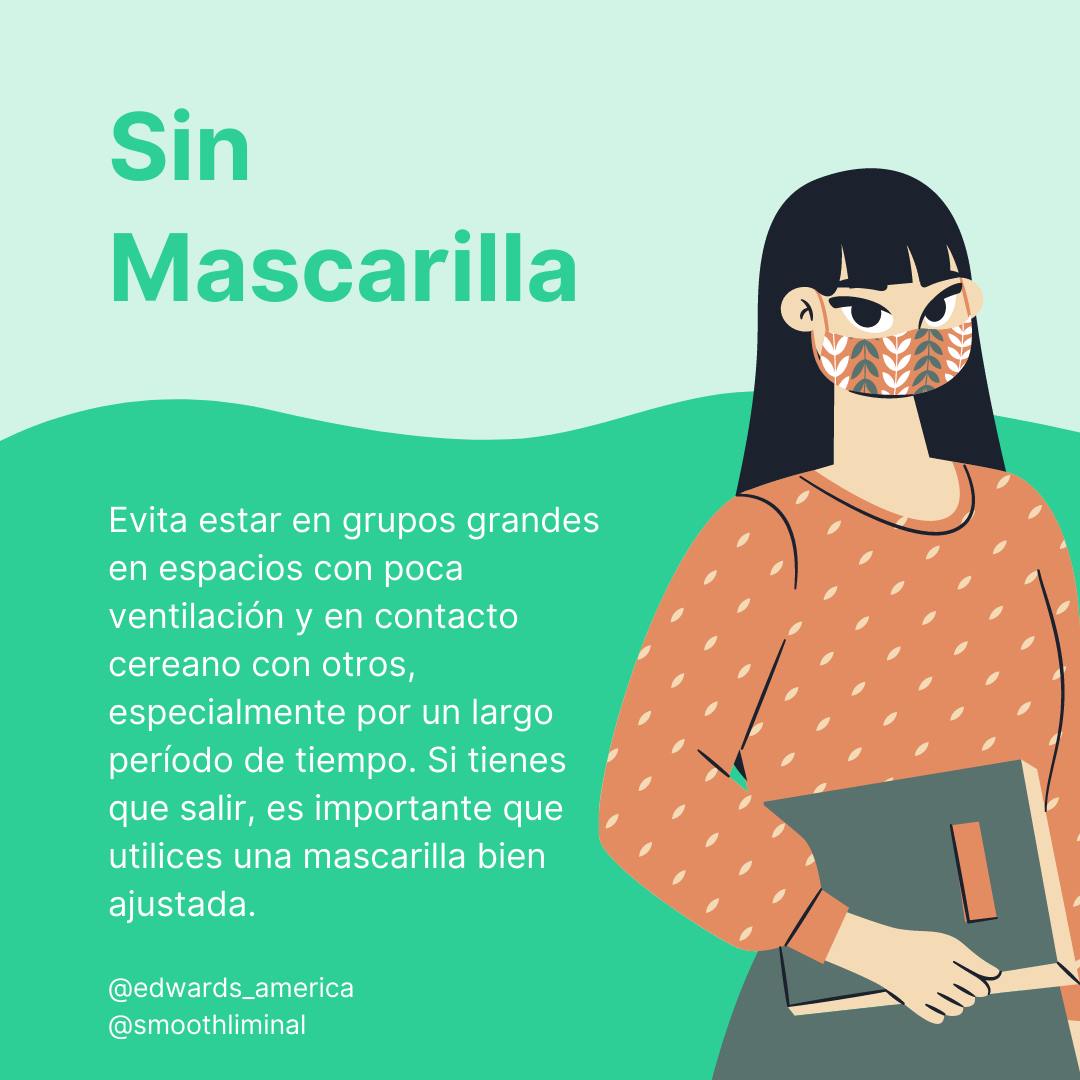
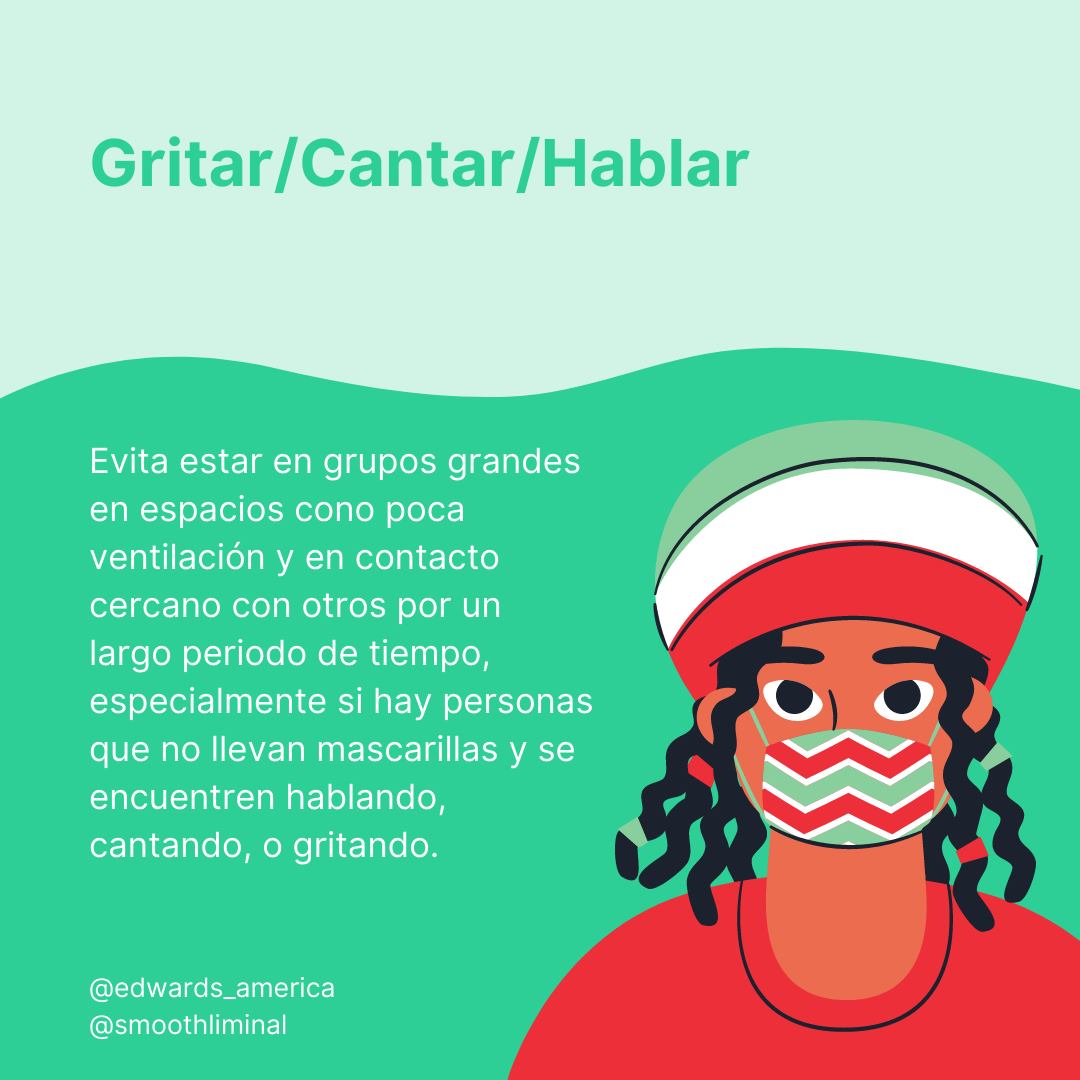
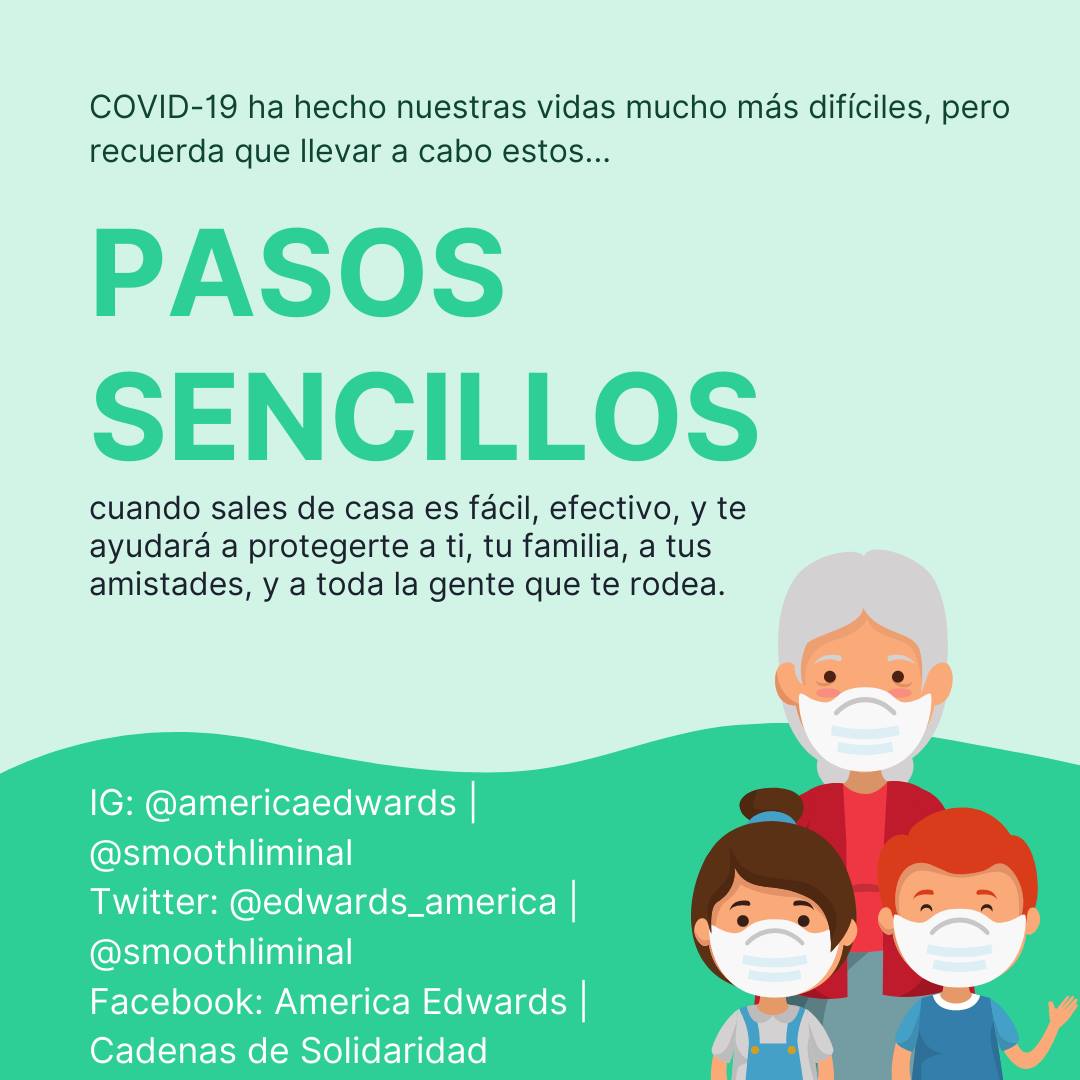
Esta semana, Cecilia Rico y yo tuvimos la oportunidad de trabajar con America Edwards para traducir estos consejos sobre cómo prevenir infecciones de coronavirus (COVID-19). Toda la información fue tomada del artículo de Time ligado aquí, escrito por el Dr. Jose-Luis Jimenez: https://bit.ly/2QsuE5C
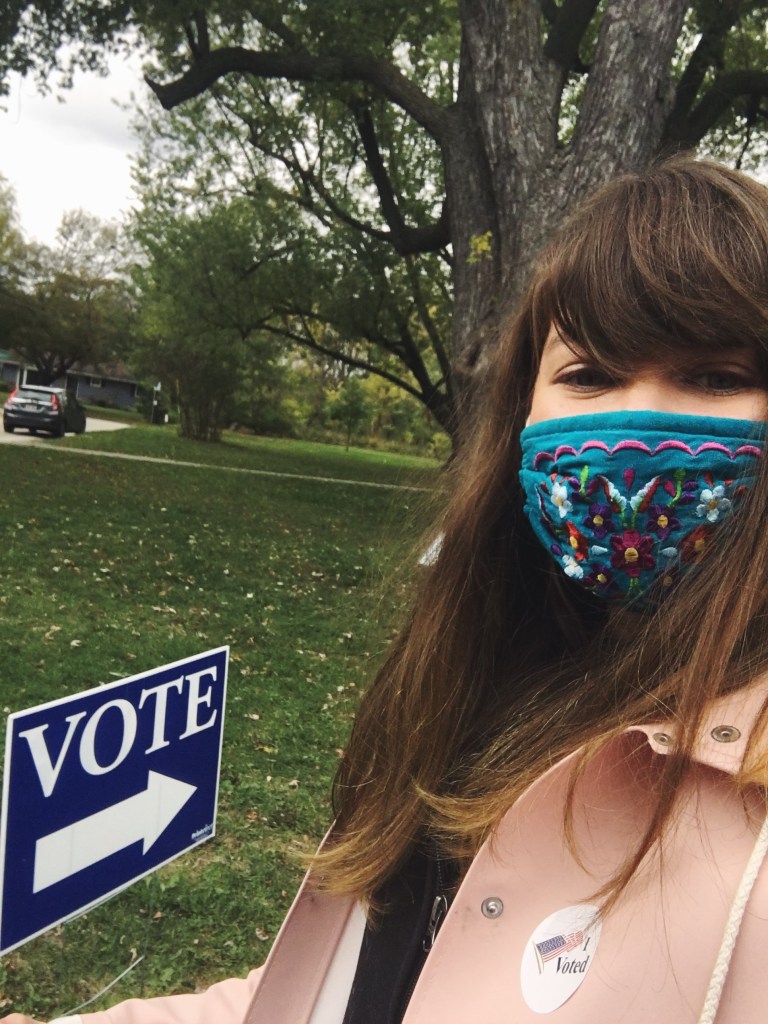
A selfie I took today after dropping off my ballot
This election, I’ve been hearing a lot about how we have to pick the “lesser of two evils,” why “voting is like taking the bus,” or how “at least Biden isn’t Trump,” and I agree with these sentiments wholeheartedly, but there are honestly so many reasons why I think that Biden and Harris are the best choice in this election. Here are just a few that I jotted down earlier this week:
Reversing some of the most inhumane immigration policies––including child separation from their families (remember the horrific pictures of kids in cages?)
Reinstating DACA and making it easier for DREAMers to get financial aid (Some of the most dedicated, brilliant students I’ve taught are DREAMers, and they’re working to become doctors, teachers, and counselors. Not giving them the opportunity to contribute to our society is a loss for all of us!)
Finally providing a path to citizenship for 11 million undocumented Americans (if this sounds radical to you, remember that Reagan did it in 1986, so this isn’t really partisan)
Investing in clean energy and holding corporate polluters accountable (because we can’t reverse climate change with small individual actions, and I should know. I take a lot of small individual actions!)
Reforming the criminal justice system, including investing in social workers, disability advocates, and mental health experts to de-escalate situations that police officers never should have been expected to handle; and eliminating private prisons and cash bail (because if locking people up is a business, then doesn’t that create incentive$$$ to do so?)
A comprehensive COVID-19 plan that prioritizes health AND economic concerns––they’re not separate issues––including free, rapid testing so that people don’t unwittingly infect the people in their communities; ensuring fair access to treatments (this pandemic won’t ever end if only the wealthy can get tested and treated); scaling up unemployment insurance; and halting evictions (I live down the street from a park that now has a homeless encampment because so many people have lost their jobs and can’t make rent. They’re my neighbors, and honestly, it could be Devin and me if we lost our jobs. We live paycheck to paycheck.)
Paid parental leave (because I love a lot of moms who had to go back to work pretty much right after their babies were born, and because maybe someday we’ll have kids, too.)
How did you learn to speak another language? I like to ask this question when I meet new people because the answers are fascinating. People who grew up in multilingual countries or regions often can’t remember how they learned a “second” language (“What do you mean? I just grew up speaking both!”). But those of us who learned a second language in places that are predominantly monolingual often talk about our language classes in a tone usually reserved for root canals (e.g. “Ugggh, I hated my Spanish classes. The only word I learned was biblioteca“).
Growing up in Mexico and then the U.S., I feel like I experienced a lot of different teaching styles from fun––like singing “Pollito, chicken/gallina, hen”––to torturous. (I’m looking at you, ESL teacher who made the Spanish speakers repeat the word “pajamas” over and over in an attempt to get rid of our accents. It was awful! Even though I speak very fluent English now, I still hesitate before saying that word!)
The more I learn about language acquisition, the more I’m convinced that learning a new language is all about how we are taught and why we are learning.
Which is great to think about, but how do you actually put it into practice? Especially when you’re the person responsible for teaching kids? At home? In the middle of a pandemic???
It’s enough to make even the most committed bilingual parents and caregivers say, “Forget it! ¡Olvídalo! I can’t! ¡No puedo!,” but then, if you’re like me, you think about how grateful you are to be able to think and speak and love in two languages and how much you want to pass that on to the children in your life.
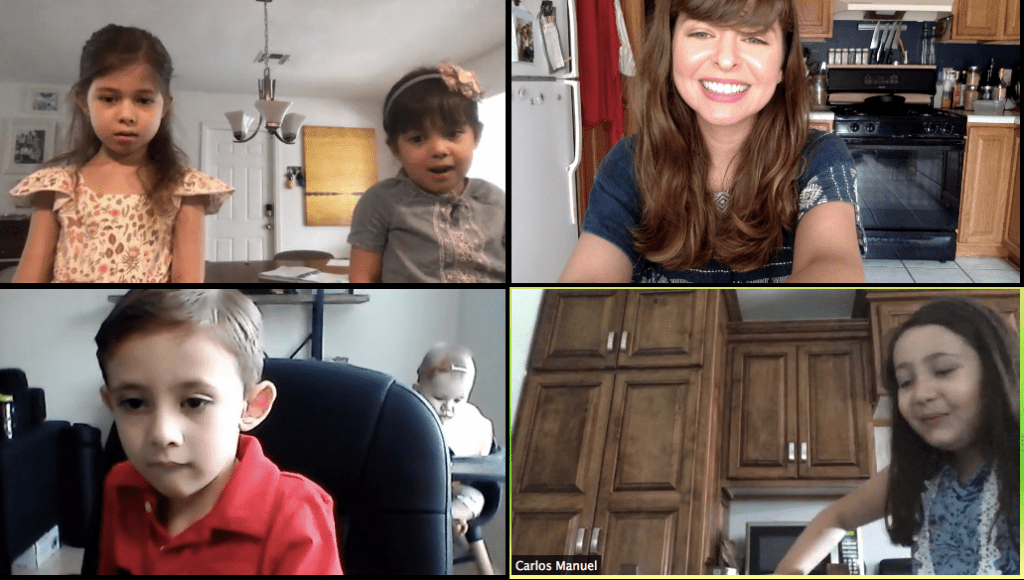
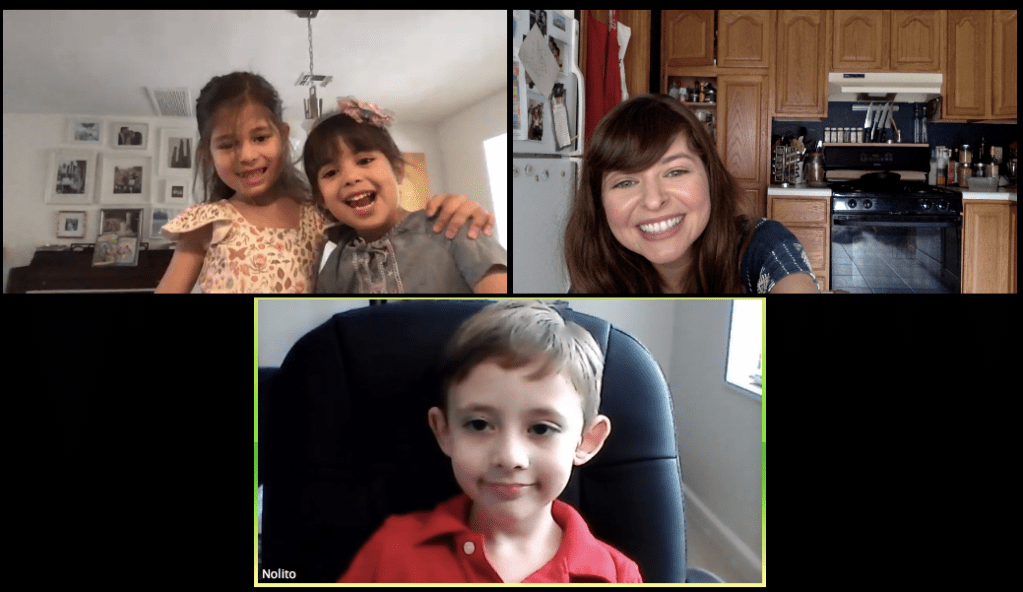
That’s where Bilinguify! comes in. Bilinguify is a 21-day class and community space for people who want to help kids learn Spanish in a fun, joyful way. I took the class this summer and learned strategies that have helped me connect with mis sobrinit@s even when we are far apart because of the pandemic.
I think Bilinguify! works because it’s not about being perfect or using traditional tools like worksheets and vocabulary lessons. Instead, this class helps us realize that we aren’t just teaching our kids Spanish because we want them to know how to use accents and punctuation or even because we know it will help them have an easier time getting a job later in their lives. Both of those things are cool, but I suspect that if you’re reading this, you probably have a deeper motivation.
Maybe you’re a Latinx parent who wants to make sure your kids can talk to their hilarious abuelita and laugh at her jokes. Maybe you grew up embarrassed to speak Spanish, and you want your kids to love themselves and your culture from the beginning instead of having to unlearn shame. Maybe you want your kids to feel empowered because they can not only understand Spanish but also say exactly what they mean to say whenever they want to say it. Maybe you don’t even speak Spanish yourself, but you’ve been troubled by news stories about increasing hate crimes and you want to make sure your children are learning to reject racism in all its forms.
Whatever your reason, knowing why Spanish is important to you makes everything easier. After guiding you through an exercise to clarify your mission, Bilinguify! offers you tons ofstrategies to incorporate Spanish-learning opportunities into your everyday life and to find community so that you’re not putting all pressure on yourself to be the perfect teacher.
Because, after all, as anyone who’s grown up bilingual can tell you, the best way to learn a new language isn’t in a standard class where you repeat new words over and over. It’s singing, playing, talking, and dreaming in that language until it becomes a part of you.
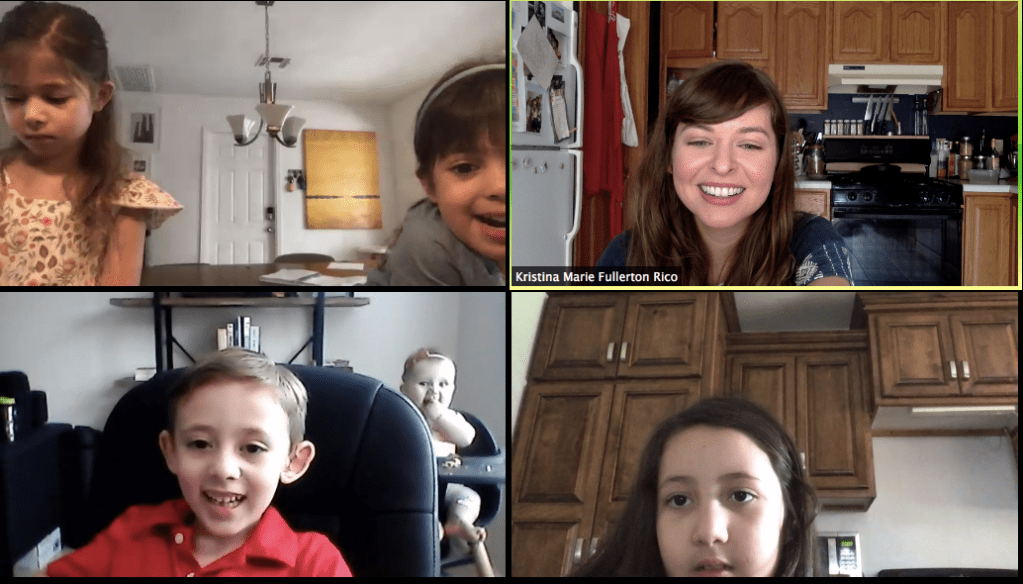
I’ve been using these tips and tricks to connect with my sobrin@s over Zoom calls and FaceTimes, so I can tell you that they really do work!
In honor of Latinx Heritage Month, Bilinguify! is on sale for $97. AND if you use the code DIEZ at checkout, you’ll get an additional 10% off. Even though you’ll be able to access Bilinguify! resources on your own time, this program is all about community, so it only runs for three weeks, and you must be registered by this SaturdaySeptember 26th at 10 pm PST. The program will start on Monday, September 28, 2020 when you’ll be able to access short videos, resources and prompts, members-only discussion forums with other community members, and Zoom calls to learn more and talk about how it’s going.
Note: Bilinguify! was created by my cousin, Vanessa Nielsen Molina, who also runs my favorite book subscription service, Sol Book Box (I wrote more about that here), but even though I know about Bilinguify! and Sol Book Box because I know Vanessa, I’ve been a full-price paying customer for years because I believe these services are worth it.
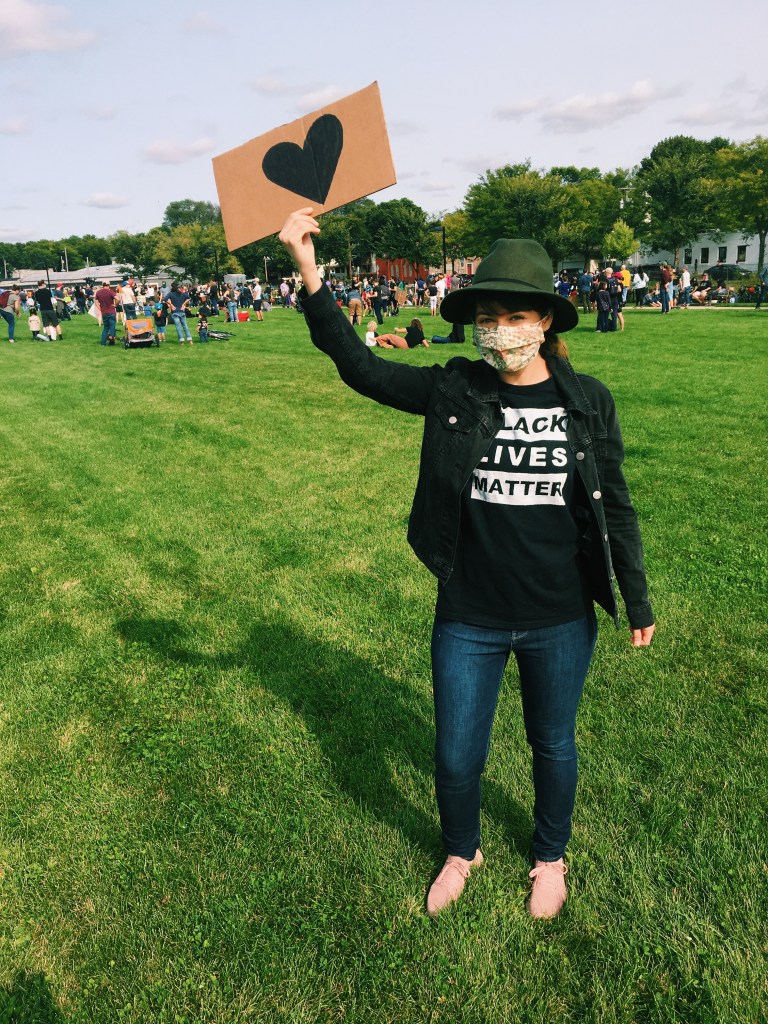
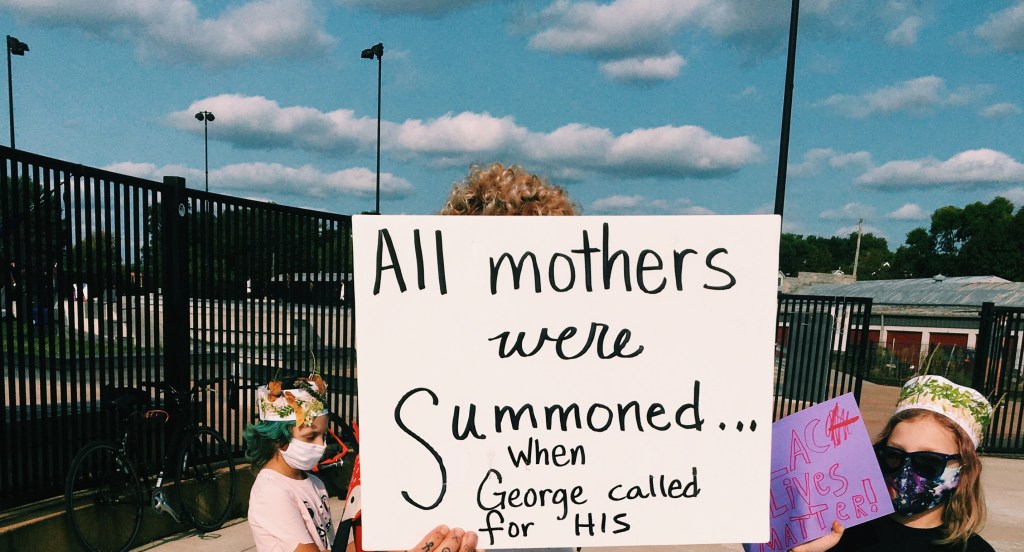
Today I went to the Kids’ March for Black Lives in my neighborhood, which reminded me that I’ve been meaning to share this incredibly useful list of how to protest while reducing risks of getting and spreading COVID-19.
Here I am holding a sign at the march. Instead of writing words, I drew a heart on my sign because I wanted it to be easy to read, even for little kids who might not read words.
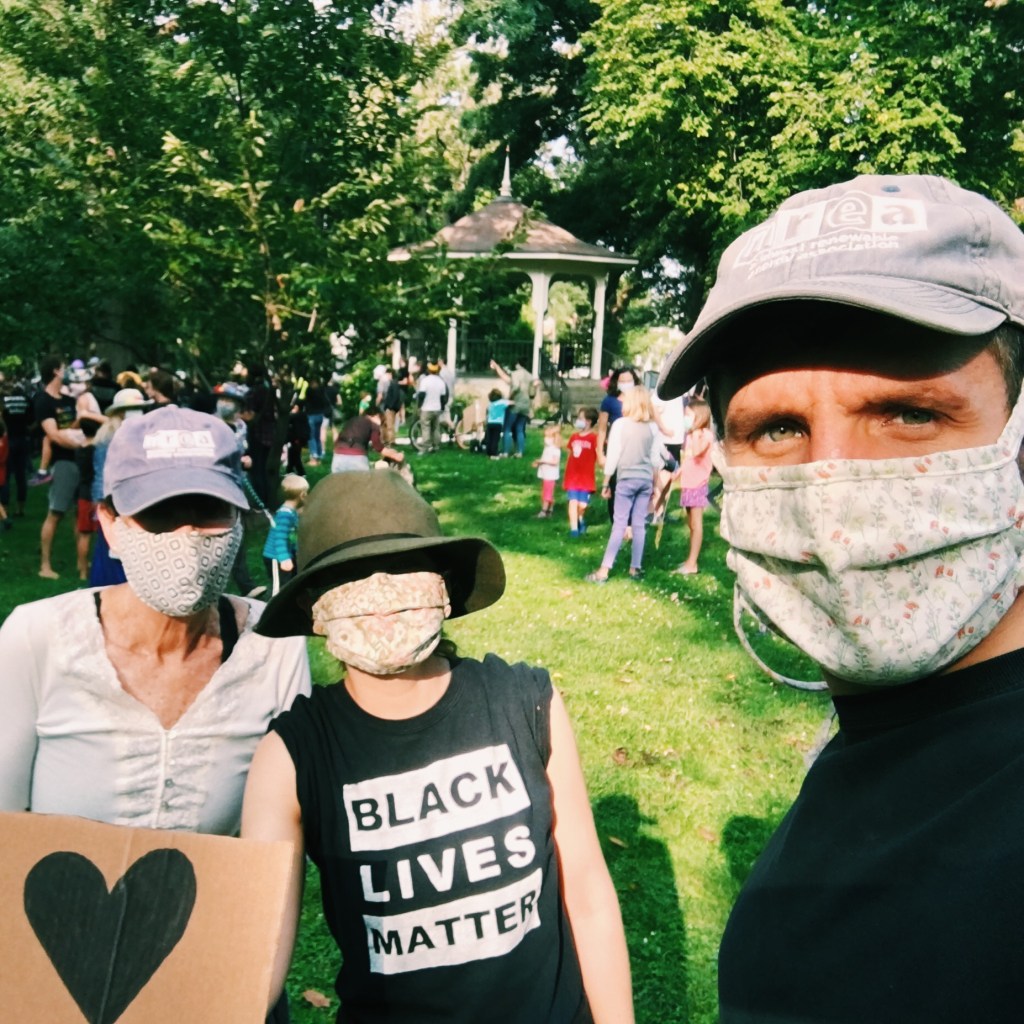
The march today was a powerful experience, made even more beautiful by the fact that I got to march with Devin and his mom, who is not only the mom of a former kid I love very much but also an educator who teaches kids today.
Anne (Devin’s mom), me, and Devin at the end of the Kids’ March for Black Lives
I feel incredibly lucky to have gotten to hear children and anti-racist parents and teachers speak about justice and safety and what it means to be in community and divest from unjust systems in order to invest in what we really need: schools, housing, clean water, health care (just to name a few).
Protesting in a pandemic is complicated, and there are lots of ways to contribute to the Black Lives Matter movement that don’t involve going outside and participating in person, but I’m really glad we were able to go and march in a way that felt safe and responsible given our risk factors and responsibilities to others around us. If you’re thinking of going to a protest, I encourage you to read this list and make a plan to participate with COVID protection in mind. Remember: we keep us safe!
P.S. The list I’m sharing here was made by my friends Alison Kopit (she/her) and Elizabeth Harrison (they/them), two of the most intentional, community-minded people I know and admire!

 smoothliminal