Ofrendas

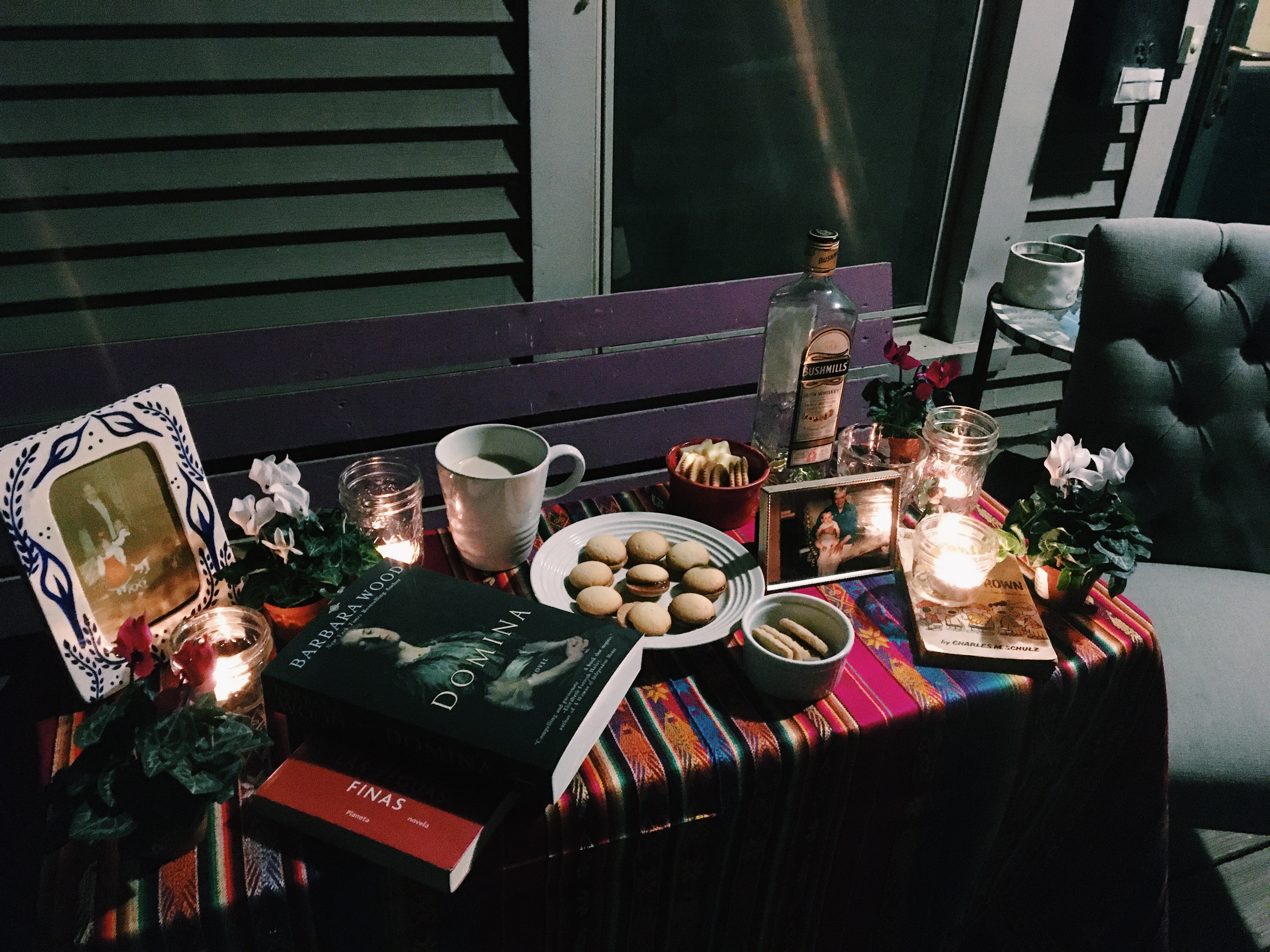
A few weeks ago, Devin and I made an ofrenda for our grandmothers. Even though I’m Mexican, my family has never been big on Día de Muertos. In fact, one of Abbita’s favorite sayings was “En vida, hermano, en vida,” which basically means “If you want to do something nice for someone, do it while they’re still alive.”

As I prepared the ofrenda for her, I could imagine her laughing and shaking her head at me, so I decided to add something she couldn’t refuse… In addition to her coffee and cookies with cajeta, I placed her favorite novel, Domina, which she liked because it is about a woman who overcomes the obstacles in her path to become one of the first (fictional) female surgeons. (Knowing her life story, it’s pretty obvious why that story would appeal to her). I also found the last book we read together, Las Yeguas Finas, so I put that one out, too. I know that if Abbita did come back to Earth for one night only, the first thing she would want is to sit down to read, and I could picture her eyes twinkling at the sight of these two books.

We also made an ofrenda for Devin’s Grandma Pat, with her favorite evening snack: cheese, crackers, and Irish whiskey. She learned to drink whiskey straight because her dad told her that it was better to know how much you were drinking than to risk drinking too many fruity cocktails, and she stuck by that rule her whole life. She also loved Charlie Brown, so we put out a book of Peanuts comics for her and an angel figurine that she gave us a couple of years ago.

One of the hardest things about the COVID-19 pandemic is that we weren’t able to gather with Devin’s family to commemorate Grandma Pat’s life. When this is over, I hope we’ll be able to go to her memorial service and share all the things we love about her with her kids, grandkids, and great-grandkids, but until then, it’s been nice to find small ways to commemorate her life, like making her an ofrenda or buying her favorite chocolate (Fannie May milk chocolate buttercreams) to share.

On the night we made the ofrendas, I thought about how I met Grandma Pat a few months after Abbita died, so they never got to know each other, but looking at their pictures in the candlelight, I could picture them talking and laughing together. It felt magical.


Ofrendas

Carolina

Processed with VSCOcam with c1 preset

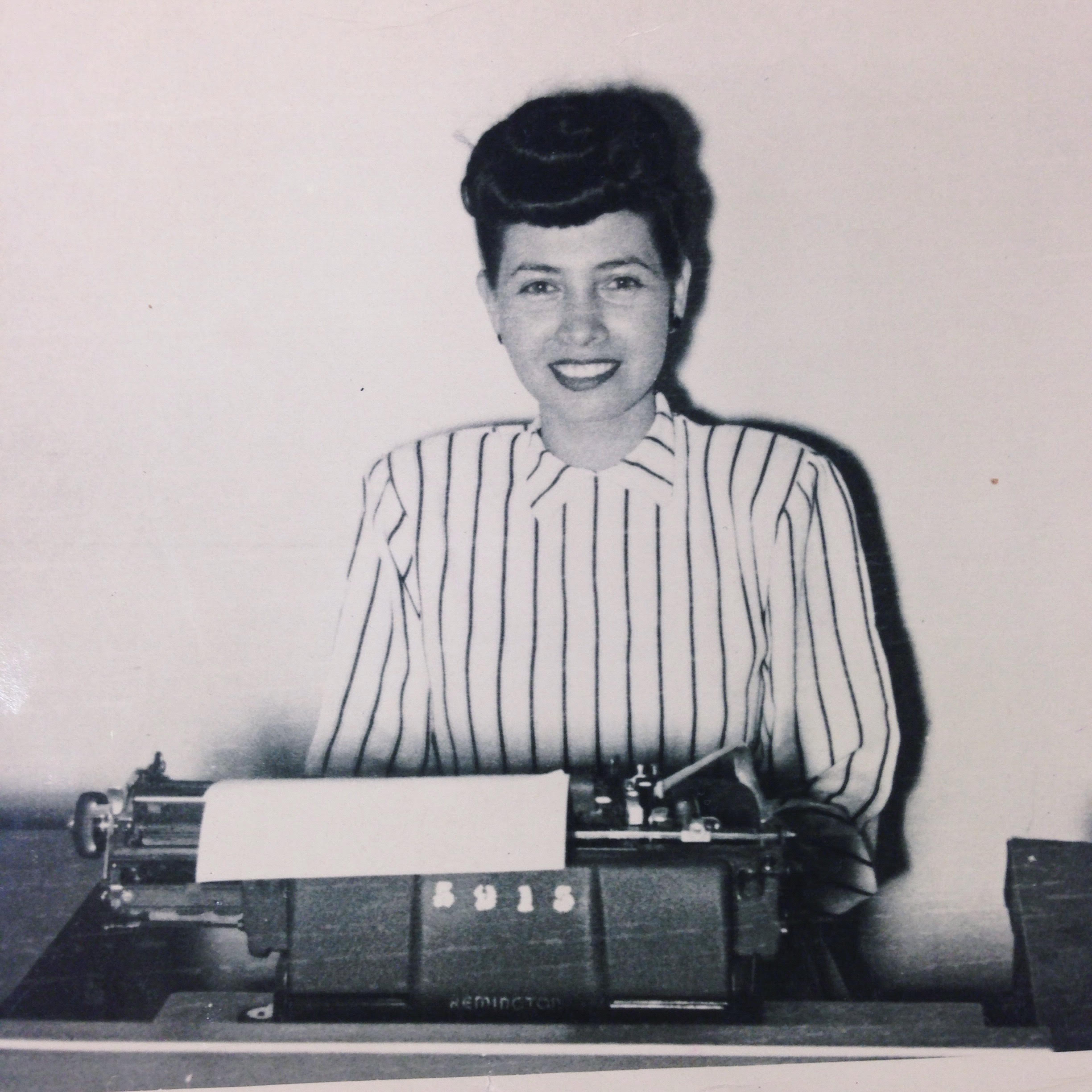
“I wanted to be a lawyer when I grew up, but since women couldn’t do that, I went to secretary school,” Abbita (short for abuelita) explained, when I called to interview her for a homework assignment about feminism. I’d been nervous to call, afraid she’d say feminism was a crazy American import or that it was un-Christian and ruining “the family” or that she was disappointed in me. Instead she told me about how she had worked for Licenciado Müller, a lawyer who helped women get divorced in Chihuahua. Abbita, whose real name was Carolina, said she loved her job because she cared about helping those women and because her boss trusted her judgment.

I never knew about any of this because she stopped working after she and my grandfather got married, but hearing this story illuminated the parts of her life I did know in a new way. It was the light turning on in a room I’d only explored with a flashlight.

All my life I’d heard about how she had been on her school’s basketball team. The girls wore long skirts as part of their uniform, but she joined the team in secret and had to hide it from her family because playing sports––even in giant skirts––was not ladylike. It was a quiet act of resistance. Like most of what she did.

My grandmother would often tell me the story of a woman who got married in the city and was soon forced by her husband to move to a little house with a dirt floor in the mountains, completely isolated from her friends and family. She would get angry telling this story and say that she supported the woman leaving her husband because the way he treated her was wrong. When I was little, I thought this was just one of those stories that grandmas tell (“This one again?”). I didn’t understand why it was such a big deal to her. Now I can imagine how desperate I would feel if I lost control of my life from one day to the next, can imagine how many women my grandmother knew who never regained it.

Whenever a woman she knew got married, Abbita would give her a little bit of money in secret because she believed it was essential that women have a way to escape bad marriages. This too seemed melodramatic to me (“Por si el marido le sale malo” sounded like something from a novela, and when I heard about my grandmother’s bridal safety-net tactics, I laughed and thought, “Too much Televisa.”)

In my own life, I’ve noticed that it is very taboo to talk about divorce if you’re married, but I don’t think I could be married if divorce weren’t legal and accessible to women. I don’t mean to imply that I take my relationship with Devin lightly, but I think marriage fundamentally changes when it is not an obligation. When I decided to get married, I didn’t have to give up my name or my rights. I didn’t have to give up my job or my dreams. I didn’t become someone’s property. I believe that Devin and I choose to be together even though we are free to leave. I believe we have the kind of marriage women like my grandmother fought for.

On the day of my cousin Vanessa’s wedding, Abbita told me a story. “I was never interested in cooking, but when I married your grandfather, I thought I should learn. He said, ‘No! Don’t take a cooking class. You should learn to play the piano,’ and he got me a piano. In the end, I didn’t learn to cook or play the piano. All I did was have babies. What kind of a life is that?”

Of course, that isn’t all she did. She did lots of things, like finding a way to own and manage properties and teaching me how to read and write and becoming so well-known for her wit that people would ask her to write their greeting cards and building relationships so strong that her children and grandchildren would fight over who got to sleep in the extra twin bed she kept in her room.

Still, I know she would have liked to do other things, too. It’s no coincidence that all of her daughters have Master’s degrees or that she gave each of her grandchildren a small sum of money when we turned 18 and said, “This is your money. You can do whatever you want with it.” She believed fiercely in independence. She took as much of it as she could and made sure we were free to have more.

Abbita didn’t go around exclaiming “I’m a feminist!,” but when I asked her to explain if she was, she had a quick answer: “Machismo means men are in charge, but feminism doesn’t mean women should be in charge. Do you know the saying ‘Behind every great man is a great woman’? Well, I don’t think anyone should be behind anyone. To me, feminism means that we all walk together, hand-in-hand.”

I think about myself at 21, nervous to call her, worried that I would have to defend feminism to my grandmother, wondering if there were any books I could give her to explain it in a way she could understand. I was so silly, thinking I’d discovered feminism when she had taught it to me all along.
Carolina

Some things worth sharing

I. I walked into a dining room full of tables with people sitting and talking and asking others to pass the salt. The whole scene reminded me of the fancy restaurant I used to work at on Sundays during the brunch rush, only the people at the soup kitchen actually seemed to be enjoying their food. It was my job to help serve in a buffet line. That’s where I met an older gentleman who said to me, “Hello, I’ve come for my lobster” and smiled. I asked him if he wanted a whole one, and he said, “Oh, yes, of course.” After he’d gone through the whole line and gotten beef, potatoes, salad, and fruit, he turned back to me and said, “Merci beaucoup” with a wink.

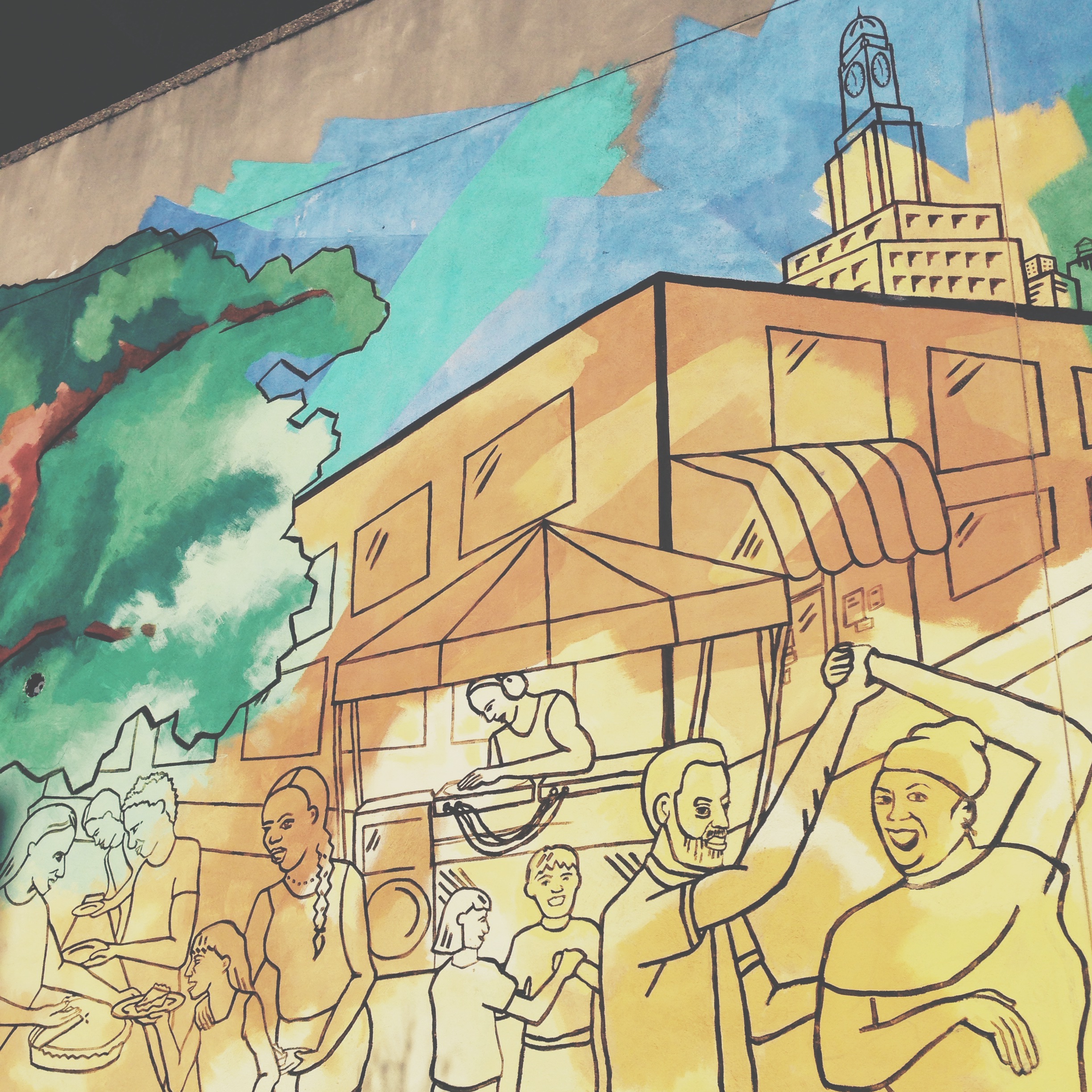
 Part of a mural near the soup kitchen.
Part of a mural near the soup kitchen.

It reminded me so much of Abbita, my grandmother. When she had to get a walker to help her get around, she called it her Rolls-Royce with a smile. She lived in a comfortable little apartment, and I never heard her ask for anything, not a new TV or a fancy anything. Like the man I met last week, she seemed to know that you don’t have to have the best, biggest, or newest fill-in-the-blank to be happy, and it doesn’t matter what’s on your plate as long as you have enough to eat and good people to share it with.

Part of a mural near the soup kitchen.

Right now, as I write this in a coffee shop, I am listening to a couple talk about how they are going to get a $6,700 couch because it is the absolute best. The world is fascinating.

II. This morning I was having a terrible day. I set an alarm, but it didn’t go off, and it seemed like all my plans were ruined, and I might as well go live off the land all by myself because there was no way I would ever be a productive member of society. I decided I might as well go eat a bagel on the promenade because it was sunny, and I might as well say goodbye to the skyline before running away to live in the forest. I was walking there, wishing I’d been smart enough to buy something to drink with my bagel, when I heard, “Cupcakes and hot cocoa for sale! All proceeds benefitting the Malala Foundation!” The two little girls were about seven years old, and I could tell it had all been their idea, everything from the sign to the cupcakes was clearly made by them, and they smiled really big when they talked about Malala. The hot cocoa wasn’t really hot anymore, but it’s the best thing I’ve had all week. When I paid the market-rate price ($5) instead of their ridiculously low asking price ($1)––didn’t their parents teach them to do market research?––their jaws dropped, and I realized all my missed plans had been worth it.

New York, today.
New York, today.

P.S. I worked at the soup kitchen for a couple of hours last week. I say “work” instead of “volunteer” because there was something in it for me (who do you think I am, some kind of altruistic chump?). Devin and I shop at a food coöp, where our groceries are very, very cheap. In return, we have to volunteer once a month. There are lots of jobs you can do in-store, like being a cashier (the prices are low because most of the labor is done by members), but there are also jobs you can do outside the store, like volunteering at the soup kitchen.

Some things worth sharing

New Year’s Eve

Tonight a bunch of my family went out for dinner and dancing to bring in the new year. At midnight, my mom, my aunt Menry, and Vanessa whispered, ‘This is your year’ when they hugged me, and my heart skipped a beat every time. And I couldn’t say anything back because I didn’t want to ruin my mascara.

I missed Devin a whole lot, especially during the dancing. But then Menry said, ‘Colecciono momentos mágicos. Creo que este es uno’, which reminded me so much of something my grandmother used to say. And then the band played the first song Devin learned in Spanish, and my aunt Martha exclaimed, ‘La canción de Devin!’

I remembered what it was like to kiss my Abbita on the cheek to wish her a happy new year, and I imagined what it will be like to kiss Devin at the stroke of midnight. And I thought about how the people you love stay a part of your life forever.

This year I finally ate all twelve of my grapes and made a wish for each one. At 12:30, my aunt Menry said, ‘We have to go because we’re getting up early tomorrow’.

But the whole family stayed until the party was over. Like we always do.

Happy new year!
kristy

New Year’s Eve