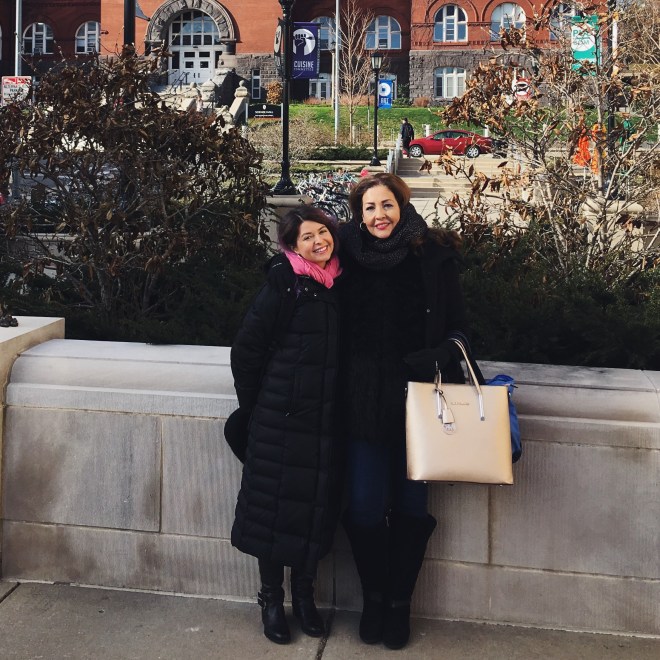
In college, I told my mom I was in a group for women of color, and she looked at me unsure. “Are you a woman of color?” she asked.
It’s the same look she gave me last month when we talked about race and migration. “I don’t really think of you as an immigrant,” she admitted.
“But we moved here together,” I reminded her.
“I know,” she said, and we laughed, remembering the things we went through. I’d get in trouble in school for following my teacher’s directions literally because that’s the only way I understood English. Drivers would stare at us on our walks to the grocery store––making it very clear that we were the only people who walked places in the Texas suburbs. A few months later, we were tricked into buying a car that would break down every 20 miles. After pouring water into the radiator or changing the oil, my mom would say “It’s God-powered, remember?” and I would nod, assured that our precarious rides were really miraculous adventures.
My mom and I have gone through so much together, and yet I know exactly what she means when she wonders if I am a woman of color or a Mexican immigrant like her.
Despite our similarities, in the United States, we have always been treated differently. I am perceived as White and American. She is perceived as brown and un-American. This difference in perception has enormous consequences –– consequences we’ll likely never know in full.
But, even though I have a lot of White privilege, I am often reminded of the fact that I am not White.
In high school, I slept over at the house of a friend who told me her brother had been robbed while delivering a pizza in the “Hispanic part of town.” The next morning, I went home replaying her words in my head. I decided that she didn’t mean anything bad by it. I reasoned that she didn’t think that hearing “Hispanic” equated with “criminal” or “dangerous” would be hurtful to me because she didn’t think of me as Latina. I mean, we both liked feminism and indie music and writing instant messages in lower-case letters. We were in a lot of the same classes. As far as I was concerned, we were practically identical.
A few months later, I was accepted to the liberal arts college she’d told me about, and I got a good financial aid package, too. She was a grade below me, and I couldn’t wait to tell her. “I got in! I got in! Now you just have to apply, and then we’ll go to college together!” In my mind, our future was set. Our lives would be a spinoff of a teen drama on the WB.
Her eyes narrowed, “I probably won’t be able to go,” she said, before telling me that she didn’t have my advantages. What could she mean by that? Was she saying that being Mexican and having a single mom were advantages, implying that I didn’t deserve to get in? I mumbled something about “need-based financial aid” and kept encouraging her to apply. I cried when I got home.
In high school, I rarely talked about race or my immigration story. I knew the kinds of things White people said when they thought people of color weren’t around, and it didn’t feel safe. (I wrote a little bit about this for Enormous Eye, under the section titled 1:43 pm, my mom’s car.)
College felt safer. My roommate was from Miami, and she told me that even though her parents were from Venezuela, her mom loved Mexico and Mexican culture. Sometimes we’d stay up late, singing our favorite Alejandro Fernández songs, and I didn’t feel self-conscious speaking Spanish on the phone with my mom.
One day, I was telling a story about my hometown in Mexico. A White friend of mine laughed and said, “I like you because you’re Mexican, but you don’t, like, make a big deal out of it.” Her tone was light, but it felt like a warning.
People often say things like this to me. Their words are subtle reminders that I can belong to their club, as long as I know my place.
* The title for this post is borrowed from the blog Conditionally Accepted, “a space for scholars on the margins of academia.”










 smoothliminal